
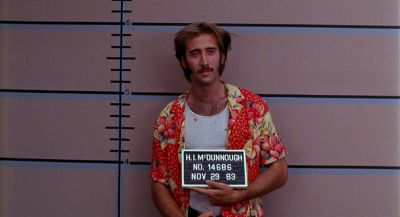
ARIZONA, RISEN
'Raising Arizona' turned 40 recently. This three-part examination of the movie's evolution starts at a city council meeting in Scottsdale.
“You’re a flower, you are. Just a little desert flower.”
— H.I. “Hi” McDunnough to the future Mrs. Edwinna “Ed” McDunnough, Raising Arizona script (revised first draft, Aug. 18, 1985)
The Scottsdale City Council met at 11 a.m. Monday, Dec. 30, 1985. Smack between Christmas and New Year’s.
Nine agenda items that morning. Nothing major. Attendees blew in and out in 20 minutes.
One matter involved acquiring property at 3701-3711 N. 75th Street from the Scottsdale Plumbing Company as part of the city’s municipal block plans. And, as a result of Resolution No. 2647, if you stopped at that address tomorrow, you’d be parked across from the Scottsdale Justice Center. The Young at Heart Bingo Club requested and received a license for games at the New Ventura Apartments. The R.G. Johnson Construction Company won the go-ahead to fix that troublesome dip and ditch lining on 84th Street north of Pinnacle Peak Road. Ambrosino’s Italian Gourmet Dining left the Kiva cleared once more to serve liquor.
But Item No. 4? We still talk about it. In fact, it’s an integral part of the state’s cultural history.
Carefree, come and gone
Opened in 1968, Carefree Studios sat two miles south of Carefree up Scottsdale Road, with its trio of 10,000-square-foot soundstages and a single Western street set. Foothills sprawled in the picturesque distance. Producer/director Richard Robinson’s To Hell You Preach was shot here in late 1971. So did The New Dick Van Dyke Show, when its namesake lived in Cave Creek. Then it got kicked back to Hollywood, where it quickly died. The Carefree lot didn’t fare much better.
State Farm Insurance Co. grabbed the foreclosed property in 1974. The name stayed. So did its buildings, though curious visitors were shooed away. There was little to see. Minimal life. Closed doors, locked. Production turned sporadic — commercials, myriad whathaveyous. The Scottsdale-based Oasis Productions planned to start Brother Monks with Harvey Korman and Tim Conway there in June 1981. Hardy Price of the Arizona Republic later reported that a looming director’s strike might move some of it to Durango, Mexico, instead. Turns out, however, Brother Monks may have filmed nowhere at all, as it doesn’t appear in either man’s filmography, or in that of its appointed director, Michael Preece.
Mostly, Carefree Studios lived up to its name, hosting benefits and other events. A place where movies were made. Once upon a time …
But in 1985, interest in the studio stirred when a film production company needed somewhere to land. The City of Scottsdale leaped into action, agreeing to lease Carefree for $61,200, then sublease it to this curious party for $65,700.
A cinematic flair
Whoever this was clearly spoke Deputy City Manager Richard “Dick” Bowers’ language. About two years earlier, Scottsdale Mayor Herb Drinkwater collared him into his office as Bowers strolled City Hall. Drinkwater wrestled a conundrum. A gaggle from L.A., making a picture called Just One of the Guys, needed settings for its gender-swap/PG-13 teen-romp plot. Within a day, Bowers finalized a deal to use the Scottsdale High School campus, shuttered in 1983 ($60,000 rent, as Drinkwater recalled).
Usually, the mayor reviewed such requests. He seemed to have been movie-mad himself, especially after reading about the wonders film did for local economies. “I got to thinking that it’s a neat, clean business,” he told the Republic’s Christia Gibbons in 1986. “It leaves tax dollars while creating no permanent environmental damage or traffic problems.”
But the experience got Bowers to thinking, too. Scottsdale, he felt, was in a perfect position to become some kind of Southwestern motion-picture epicenter. He subscribed to Variety and studied it so deeply that, like a real mover, he could yank any germane detail from the ether and toss it into conversation. Runaway productions, for instance. What are those? He could tell you: anything shot beyond California. And that loss cost the state $1.5 billion in 1984.
So, how much money could the industry pump through local blood?
“This is a whole new economy base that is recession-proof and not dependent on tourism,” he reasoned.
Of course, Arizona was never, in any way, foreign to film or television, going back to the genesis of each. Film Phoenix, opened in 1974, took care of its own backyard. Other cities and communities maintained offices, too, as did the state. Attractive climate and vistas made the whole realm ideal for Westerns (see: Old Tucson, Prescott, Monument Valley, and Sonoita), and versatile landscapes easily conveyed other locales. In 1977, Claude Lelouch shot his French-language Un autre homme, une autre chance (Another Man, Another Chance) in part around Tucson and Patagonia, drawing $250,000 to the state. Some 12 months later, William MacCallum, director of Arizona’s Motion Picture Development Program, calculated that the industry would spend $16 million statewide during the Me Decade’s last year, adding, “I don’t see it slowing down any.”
It was a prosperous period, overall. Barbra Streisand brought A Star Is Born to Phoenix, fortifying the Ramada Inn on East Van Buren Street with ever-present guards. Clint Eastwood sped a bus through the city’s Civic Plaza for The Gauntlet. As the ’80s began, George Lucas brought Return of the Jedi scenes to Yuma. MacCallum congratulated Flagstaff for hosting a smooth, successful shoot for Warner Bros.’ National Lampoon’s Vacation. “Our office can’t buy advertising that has as much impact as a happy production crew returning to Hollywood … has in selling Arizona to the motion picture industry,” he beamed in a September 1982 letter to both Mayor Paul Babbitt and that city’s Sun.
But the boomtimes tapered off. “Probably our best year was 1979,” MacCallum reflected, only weeks before the Vacation crew left, “when more than $20 million was spent by film people in Arizona. That slacked off to $16 million in ’80, $13 million in ’81, and we expect $8 or $9 million this year.”
Nevertheless, there were benefits.
“[The film companies] don’t pollute the air,” MacCallum told the L.A. Times’ Claudia Luther. “You don’t have to build schools, sidewalks, or sewer systems to accommodate them. They take advantage of what’s available. The only real residue is the money they’ve spent. And everybody has made a killing while they’re there.”
To read the story in its entirety, visit our Substack and create a FREE or PAID subscription. Thanks for supporting independent journalism!

