
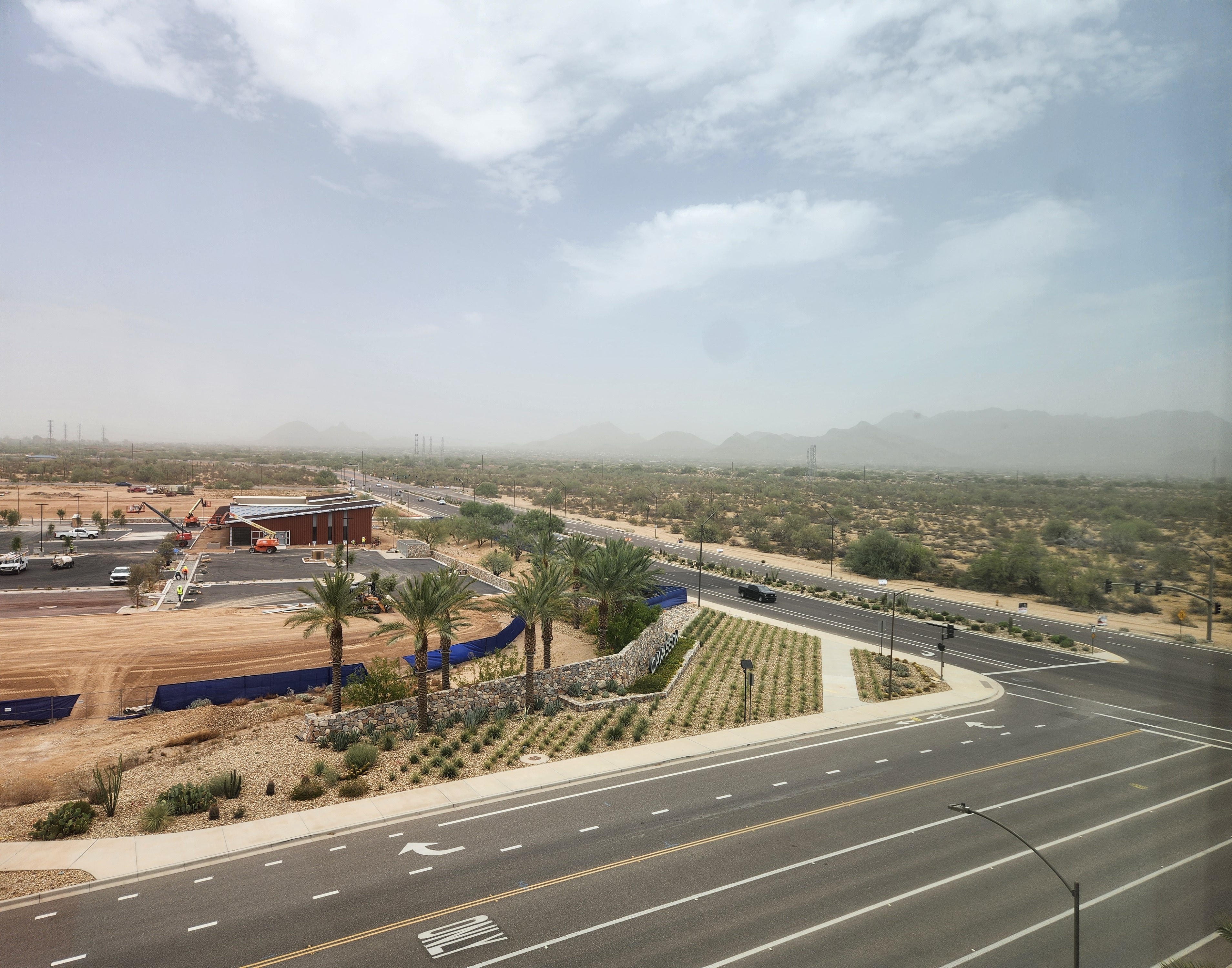
Photo: Cory Frye
ARIZONA, RISEN chapter 3: The Dream of the Future
The Raising Arizona deep dive's final installment.
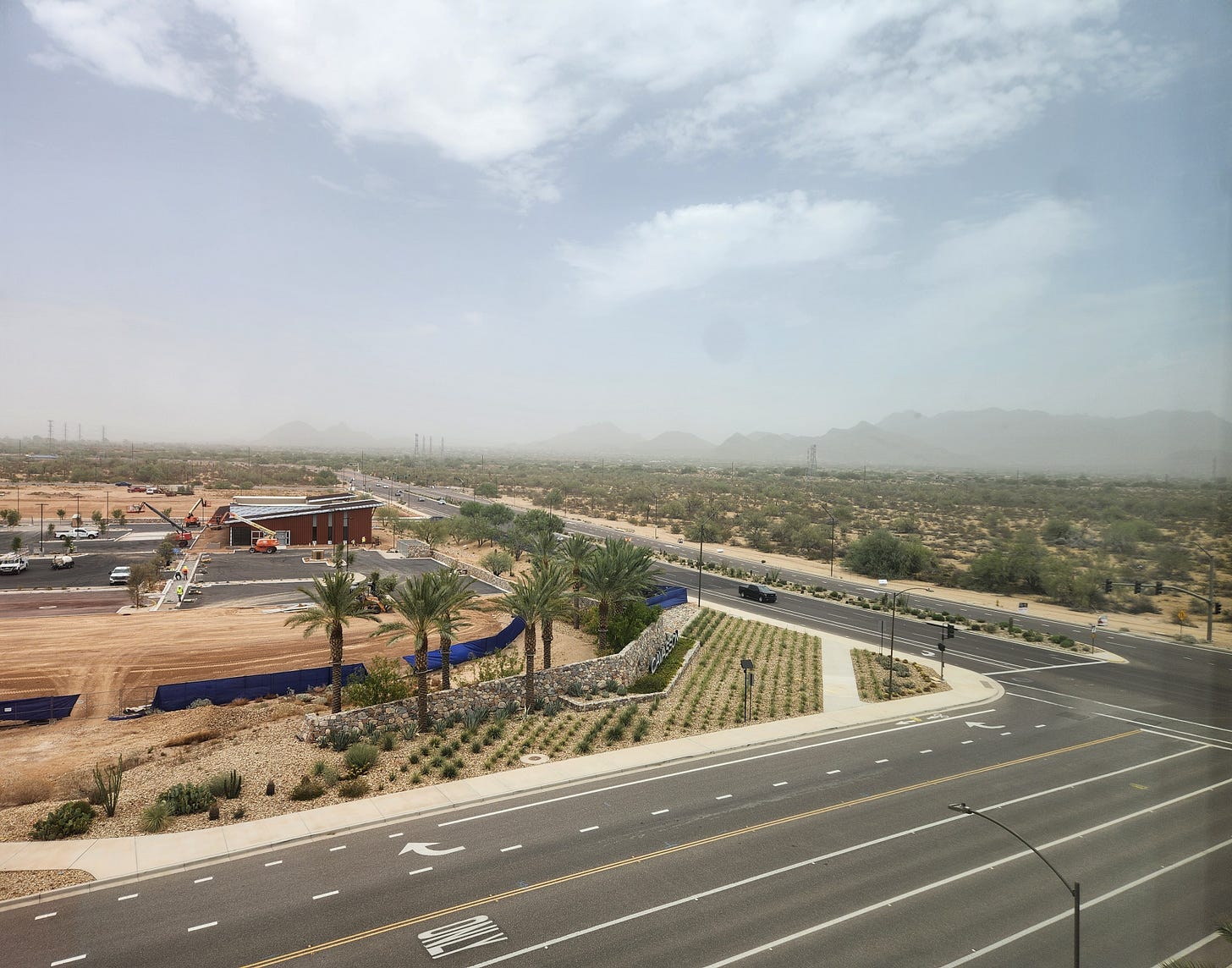
'The misty horizon beyond Cavasson Boulevard and Hayden Road, Scottsdale, 1:10 p.m. Tuesday, August 4, 2026. Photo by Cory Frye.'
By Cory Frye
“[T]he whole ending of Raising Arizona was like, you know, sappy about them eventually having this big family and going into the sunset in their old age — sentimental bullshit.”
— Frances McDormand to Todd Lippy, Projections 11: New York Filmmakers on New York Filmmaking (London: Faber & Faber, 2000)
“The whole dream,” Hi McDunnough wonders against his sanctum’s darkness, “was it wishful thinking? Was I just fleeing reality like I know I’m liable to do?
“But me and Ed,” he counters, boarding sunnier trains of reflection, “we can be good too. And it seemed real. It seemed like us, and seemed like, well, our home. If not Arizona, then a land not too far away. Where all parents are strong and wise and capable, and all children are happy and beloved.
“I don’t know,” he shrugs somewhere in his mind. “Maybe it was Utah.”
The screen turned black. Carter Burwell’s “Way Out There” jolted to sudden exuberance. John Crowder’s sharp yodel broke the ruminative flow. Ben Freed loosed some banjo. The end-credit titles began. “Directed by JOEL COEN” came and went. It was over, nothing left.
Scottsdale mayor Herb Drinkwater wasted little time rising to his feet. His wife, Jackie, followed.
The city’s UA Movies 5 on the Mall Cinema was packed that Tuesday, March 30, 1987, for the Southwest premiere of Raising Arizona. Some 500 people came by invite, but the screening lacked exclusivity. Few attending faces sold magazines. Nor were many bodies gala-attired, save Channel 12 reporter Bill Andres, dressed to the nines as official emcee. (Like fellow tele-journalist Bill Rocz, he, too, appeared in the film.)
Nic Cage was supposed to show; the night, alas, did without. Co-producer Mark Silverman was the film’s only non-Arizonan rep. All 15 babies, now toddlers of light erudition, milled about with parents. John O’Donnal of Apache Valley — fully bearded and natty in cowboy hat and sports coat, sartorial galaxies past his beleaguered pickup captain in the post-robbery chase scene — regaled reporters with his sole on-camera observation (unless you count a lot of screaming): “Son, you got a panty on your head.”
The Drinkwaters were supposed to hang back and hobnob in the lobby, maybe bask in the afterglow, but they did not. Instead, they left.
Herb was not happy. He’d just endured 1 hour and 34 minutes of two filmmakers mocking his state, his people, twisting them into rotbrained slackjaws who barely seemed to realize that the century’d turned some 80 years earlier. There were no signs of metropolitan cityscapes, no urban sophistication, just vapid blue skies over craggy hills tossed in like some Bob Ross matte. Drinkwater felt they’d all been swindled by a company promising a movie, then submitting condescension in its stead. Arizona was more kidney stone than come-on.
“The kids were cute, and there were some funny lines,” he admitted later to the Republic’s Gail Tabor. “But hand-grenading the rabbit and shooting the lizard ticked me off. It certainly isn’t the image Arizona wants to project. … I couldn’t stand here and say it was good. There was no redeeming social value to it. How do people even think to write something like this?”
“It pokes gentle fun at humankind and our foibles,” co-producer Silverman retorted. “It wasn’t the intent to ridicule Arizonans.”
“It’s more a Minnesota state of mind,” Joel Coen explained.
(Bill Rocz was disappointed, too, apparently, but for different reasons. He didn’t show in Scottsdale, having seen Raising Arizona already in L.A. “They cut my lines,” he complained. “I was destroyed. I found out it was lonely at the top.” The screening also confused some of the Arizona quints’ real parents. Wasn’t this a kidnapping movie, not some Chuck Jones/Walter Lantz foofaraw, with Nicolas Cage capering about in Woody Woodpecker’s pomade — and a Woody tattoo, to boot! — like some pants-on-fire numbnuts?)
Explanations didn’t seem to matter. Umbrage charged discourse. Marsha McCreadie leveled the movie in print, devoting her first salvo to most of The Arizona Republic’s page F3 two nights before its Scottsdale bow. “Movies does state no favors,” its subhead snarled. “Despite brothers’ intentions, it features ridicule or scorn.” A slightly acidic tongue-bath commenced. If Blood Simple pilloried Texans, Raising Arizona depicted its state’s population as “materialistic, good-natured, and simpleminded. … well-meaning buffoons who manage to screw things up.” Her later review was similarly offended, even when cut to a capsule.
Careful though it came,* *readers sensed the venom. Terry Tryon of Glendale mused, “The out-of-state critics have mostly found the movie to be funny, innovative, and intelligent. Despite assurances of their objectivity, in-state reviewers imply that the movie is bad because it presents Arizona as a land of redneck yokels.”
For the sake of disclosure, The Tucson Citizen and Daily Star squeezed more accolades into their estimations. And not *every *outside critic loved it. No less than Roger Ebert clobbered the Coens with “The movie can’t decide if it exists in the real world of trailer parks and 7-Elevens and Pampers, or in a fantasy world of characters from another dimension.”
The film proved a modest success, hauling home around $23 million in domestic receipts. It limped into 1987’s Top 50 grossers, scooting past Streisand/Dreyfuss vehicle Nuts and Universal’s folly, Jaws 4: The Revenge. One of those is deservedly obscure; the other requires a coma to forget.
Nevertheless, Scottsdale Deputy City Manager Scott Bowers was pleased. History failed to note his verdict, but he audibly loved what Raising Arizona did for his city. “The filmmakers spent $1.8 million [here], and that’s not even a high-budget film,” he calculated. “It was a successful venture, so we are looking at ways of luring more film companies to Scottsdale.” William MacCallum reportedly enjoyed it, too, visiting during filming to distribute hats.
But, like Hi McDunnough, let us now dream even further …
The future comes for everyone
So here we are, a tenner short of 50 years. Many of the above-named people have left us. The Coens have made 16 other movies, including one remake (2004’s The Ladykillers) and three well-regarded adaptations: O Brother, Where Art Thou?, setting Homer’s ancient Odyssey upon land that stirred 20th century American blues; Charles Portis’ True Grit (2010), responsible for, first, a 1969 John Wayne classic, then a postmillennial reshaping that trumped it somehow; and Cormac McCarthy’s No Country for Old Men (2007), which landed the brothers their first Best Picture Oscar. They’d won two previously for Fargo (1996): Best Original Screenplay and Best Actress, the latter for Frances McDormand, a Dot no more. It even inspired an FX anthology series helmed by Noah Hawley.
Joel and Ethan have each released projects with varying results. Yet together, their touch remains distinctive, even if not always grasped immediately. See also: Fargo follow-up The Big Lebowski (1998), No Country chaser Burn After Reading (2008), or classic-Hollywood send-up Hail, Caesar! (2016), wheeled in hot on Inside Llewyn Davis’ ratty-ramen coattails.
Arizona’s changed massively since the Coens set up shop. Cities have grown, eating desert as they expand. Demolition crews came for Carefree Studios in August 1999; one of its last hurrahs was Paul DeGruccio’s basketball movie 3 on 3, featuring Cedric Ceballos of the Los Angeles Lakers and Shawn Kemp of the Seattle Supersonics. (Sadly, like many of its Carefree-lensed ancestors, its eventual status remains unknown.) Into a portion of its 160-acre open grave slipped a shopping center, The Summit at Scottsdale. Neighborhoods erupted around it, no longer a desolate creep through nowhere. “The ground,” Danny MacCallum sighs, “was just worth too much money.”
“It was like driving to the boondocks, the studio,” Asch Smith says. “Even the people who worked on the set, we’d all get there and ask, ‘Man, where’d we just drive?’ I only lived right down on Thunderbird and 65th Street, so I wasn’t really far away from it, probably 20 minutes. There were no homes. There was nothing.”
A similar denouement awaited Reata Pass, where she once swallowed gnats for a baby’s amusement. Both steakhouses became ancient history, razed more than a decade ago. Today the Snoates wouldn’t be robbing a country bank; they’d be scaling a sound wall to ransack deepening suburbs. The water tower and a nearby structure still dawdle, more rusted than rustic, hosting little but ghosts.
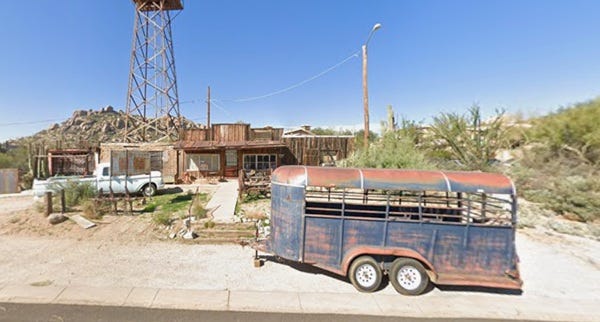
'Google Maps view of the Grease Wood Flat location at 27400 North Alma School Parkway, Scottsdale.'
The same can’t be said for the desolation that once enveloped Hi and Ed’s desert trailer, planted atop what passed for the wrong side of Tatooine. No one would dare allow them to park there now, near the Carino Canyon development, where the median list price for housing is $1.5 million. Progress, folks say.
Elsewhere, Holly Hunter became a household name, as Joel Coen prophesied, though he failed to foresee the Oscar and nominations. John Goodman’s career took off and never came back. Trey Wilson completed eight more movies, then succumbed to a cerebral hemorrhage in 1989, shortly before he could reunite with the Coens for Miller’s Crossing (1990).
Perhaps the most striking loss was Todd Michael Bogers, who appeared in Raising Arizona’s final dream sequence as the teenage Nathan, Jr., football star, BMOC. Shortly before 1:30 a.m. Saturday, December 7, 1991, the 23-year-old and his longtime friend, 24-year-old Cory Holmes, were shot to death in the Hyatt Regency Scottsdale parking lot following an altercation. Police arrested their suspected killer, Kevin Osborn, in 1996. The following year, he received a 30-year prison sentence.
The incident in part prompted Bogers and Holmes’ old Chaparral High classmate Rick Smith to start AIR TASER, Inc., with his brother, Tom. Their company modified the existing weapon, replacing its gunpowder with darts coupled with 15-foot-long wire coils through which electric currents traveled to incapacitate targets. Now Axon Enterprise, the firm maintains seven global offices, including its Scottsdale headquarters, dedicated to “making bullets obsolete.”
T.J. Kuhn and his filmic siblings grew up, started families, and dealt with Raising Arizona in their own ways. Kuhn himself first confronted his association with it in public, really, in late 2004, when a friend arranged for him to crash a radio-station interview with Nicolas Cage, then promoting National Treasure. The reunion was brief, even anticlimactic; Kuhn was distracted, driving to a function. “My parents said you were a super nice guy,” he told the star.
(In an earlier brush, Oprah Winfrey asked for comment on the film, but he “had nothing to say.” “That’s my claim to fame,” he adds. “Oprah said my name.”)
Raising Arizona remains a wonder to Kuhn. He keeps in touch with fellow baby Cody Ranger and has never been without Julie Asch Smith. She’s his little sister’s godmother. (A Coenish twist: He became a firstborn, after all, accruing two half-brothers and three stepsisters in the meantime.) They’ve visited each other’s homes. She witnessed many of his milestones. Sometimes he uses her timeshare in California. From analog to digital, their communication is always open. “I love him,” she says, “like a son.”
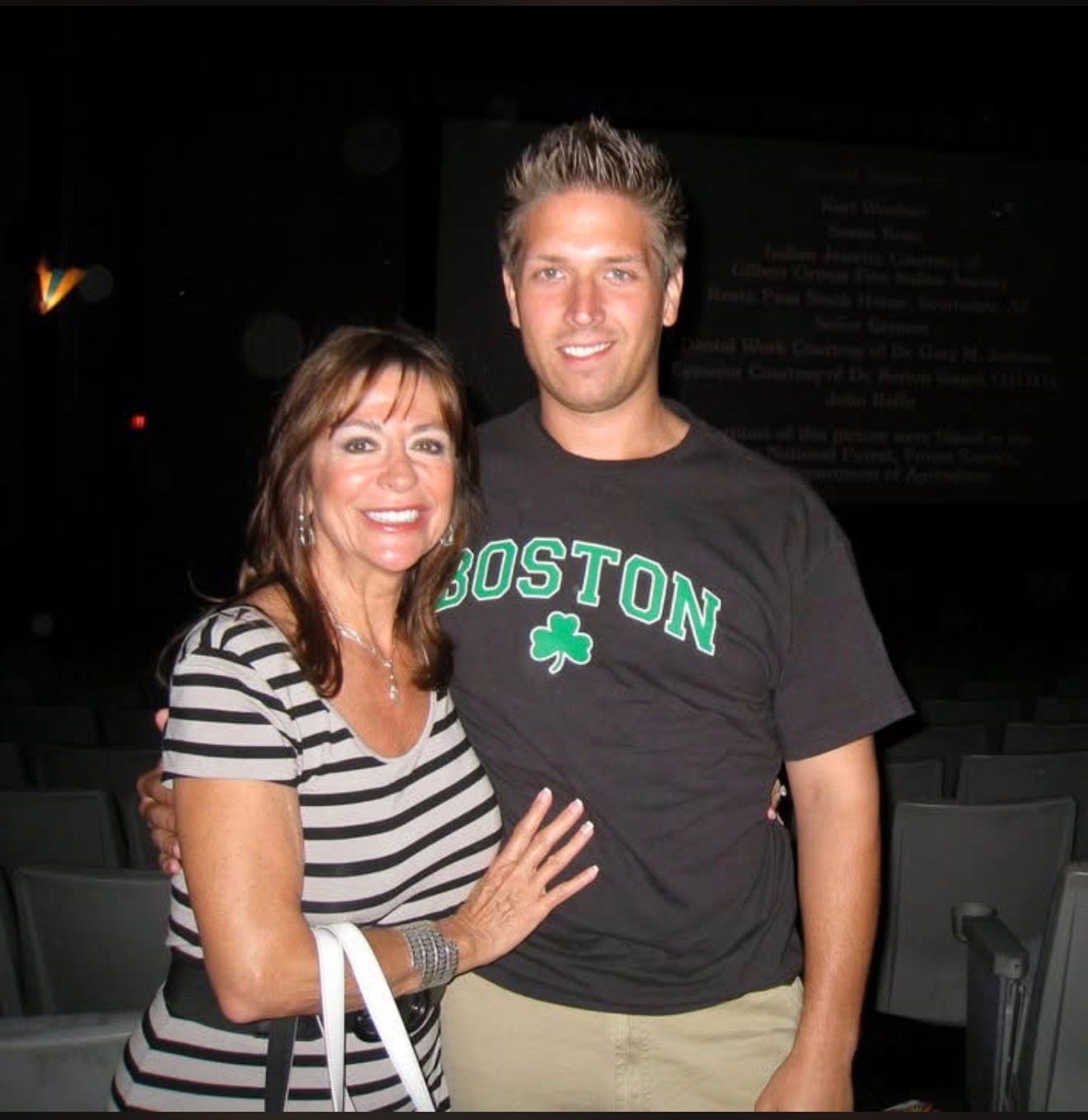
'Julie Asch Smith with T.J. Kuhn. Provided by Julie Asch Smith.'
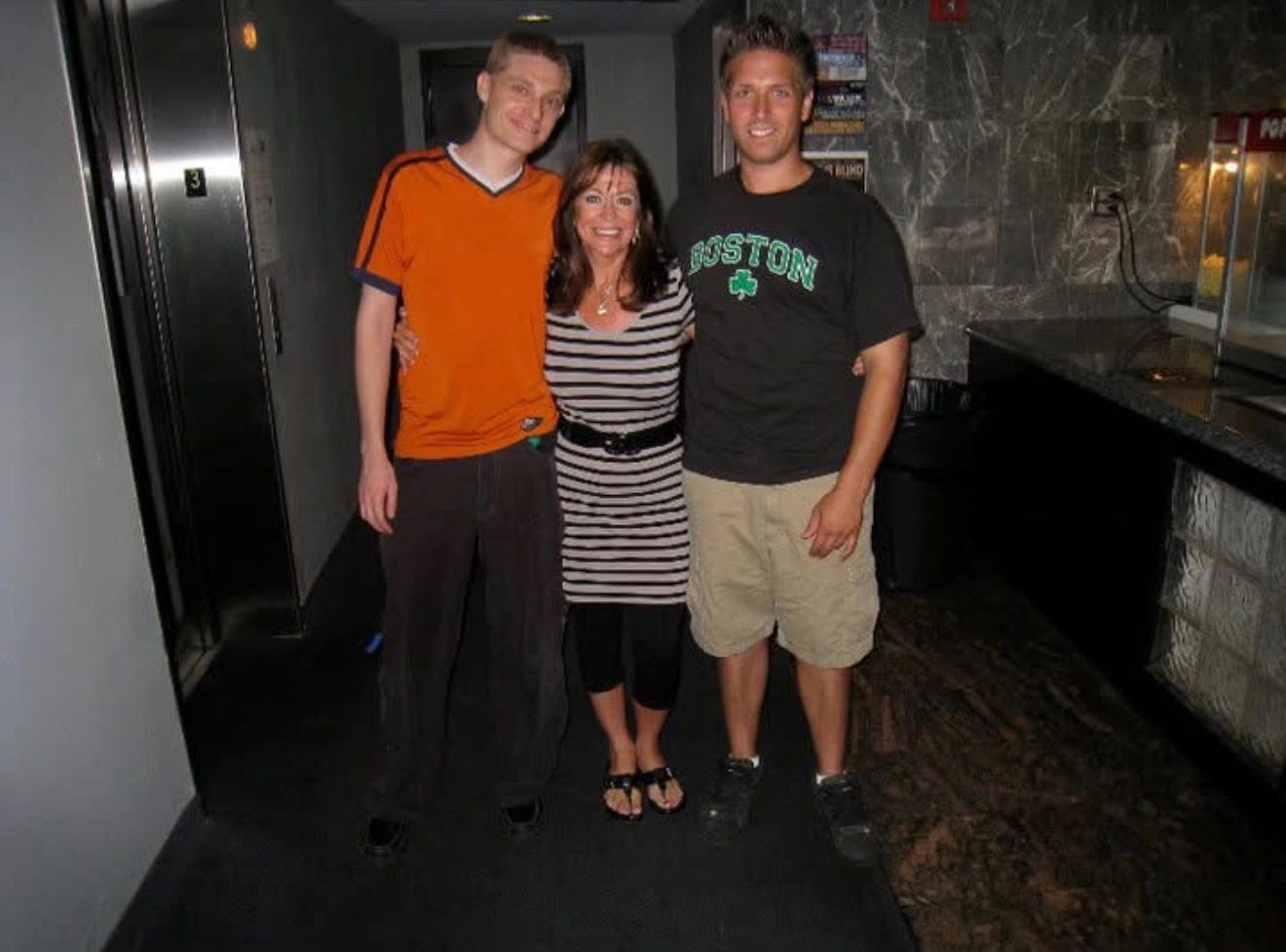
'Julie and T.J. with former Arizona quint Cody Ranger, left. Provided by Julie Asch Smith.'
Of course, time has other benefits, too— chiefly forgiveness and acceptance. In the ensuing decades, Arizona’s learned to love the movie it once believed a cruel insult, acknowledging production anniversaries as they pass, directing visitors to its extant locations. But then, many of its participants never understood the dudgeon in the first place.
“I didn’t know why they felt that way,” Asch Smith says of the backlash, “like they were being put down. I don’t think people who’d always lived here minded it as much as people who came from urban cities, who didn’t want others to think they lived somewhere like that. But I loved how the Coens put things together. I thought it was great, and I’m glad we have it. It’s nice to have that history.”
Debbie Knoblauch’s assessment is more pointed. “It’s just a movie,” she explains. “I’m sure that having been made by the Coen brothers explains why people like it now. They love the overall work, and rightfully so. People do that a lot, though: They think a movie represents where it’s set. But movies are not real life.”
Danny MacCallum offers succinct advice: “Stop taking yourselves so damn seriously.”
“I think it hits home, to be honest,” T.J. Kuhn muses. “That’s how we are, personally. I would embrace that 100%. It’s just filming Arizonans, a perfect portrayal.”
Arizona Raised
The true test of a touchstone’s power is its echo. Comb the YouTubed thousands who loiter giddily before an otherwise blasé Circle K or regal Jokake, like they can’t believe they’re standing where Nathan Arizona told creation to watch its butt, where much of their tribe has flocked. Take, say, Victor Moreno and Ruby Tate of Phoenix’s Cult Classics film series. “Be careful,” the ebullient Moreno cautions from a five-year-old video, “’cause it’s a fancy-ass place, but I’m kinda jazzed to be here in my little film-nerdy mode.” He won’t be the last to feel so reverent in the Phoenician dirt, feet from where Barry Sonnenfeld sent a camera up a ladder.
The Coens — in 1987 just two filmmaking brothers of little consequence — have no less than 40 books devoted to their canon, many of a philosophical bent. The Big Lebowski went from misunderstood misfire to comedic religion. Literally. Festivals celebrating its Westerleyed protagonist transpired worldwide, seducing Dudes by the abiding thousands. O Brother, Where Art Thou? resuscitated Americana while Inside Llewyn Davis renewed curiosity about MacDougal Street folk.
T.J. Kuhn talks up No Country for Old Men, drawing parallels between it and Raising Arizona. It wasn’t a Coen story, but it very well could have been. The former’s humor was subtle, the other’s blatant, but somehow, they shared a mind. And how different, really, was the antagonism between Hi McDunnough and the Lone Biker of the Apocalypse from the one that pushed Llewelyn Moss and Anton Chigurh to their fates? Both pursuers possessed inhuman tracking prowess, though only one turned out to be lethal.
In the late 2010s, film producer/director/artist Rick Dallago tried something novel: a documentary exploring Raising Arizona through the eyes of its grown-up junior cast. It took him about a year. Though he did not complete *Arizona Raised *to his satisfaction, it remains valuable. A fascinating, human hook, too.
Dallago wasn’t some convert gorged on Coen lore, gunning for retrospective clicks. He was around before all that, catching the film before its theatrical push in spring 1987 while visiting his sister in Sacramento. He’d just earned his first Hollywood credit, as a location manager on Elaine May’s *Ishtar *(1987), and he wanted to watch his name pass in the final reel. So he attended a press screening, where Raising Arizona was added as a second feature. (Both would tour cinemas simultaneously, though one received far less coverage than the other, a decidedly good thing. (1))
“But,” he says, “Raising Arizona was so much better. And that stayed with me a lot.”
Dallago grabbed plenty of high-profile gigs afterward. Even produced and co-produced his share. *Crazy/Beautiful (2001), Blue Crush (2002), Into the Blue *(2005), and *Turistas *(2006) come to mind. But sometimes he thought about Baby Boom, the 1987 Diane Keaton comedy about a career yuppie suddenly saddled with a child. He handled its locations, too, shooting restaurants all over New York. If an address had a menu, his camera was there.
Boom landed inside an unintended diaper-ssaince, amid an abundance of tot-centered fare. Three Men and a Baby. Look Who’s Talking. Even John Hughes graduated from adolescent angst to She’s Having a Baby,* as his muse, Molly Ringwald, mothered a newborn in For Keeps*. And, yes, there was Raising Arizona.
“I worked on a lot of movies that had babies in them,” Dallago explains, “so I’ve seen how they’re handled on sets.”
For further inspiration, he turned to the late Michael Apted’s long-running Up documentary series, which has tracked 14 Englanders for 60-plus years, beginning at age 7 in 1964.
“What interested me here,” he says, “is how these children were selected — all born within one month of each other, all from Phoenix and Scottsdale, all hired for shared similarities. What were they like now? How different were they? I didn’t realize how different until I tracked them all down, and it was interesting to see how varied they were.
“T.J. was the mellowest baby,” he continues. “There are guns going off, people screaming and yelling, a lot of high energy. But he’s deadpan. He’s the audience. Show me the baby, and I’ll show you the adult.”
Dallago left the industry after another aborted project. Cielo Drive would have focused on Sharon Tate’s family up to and following the Manson murders, as well as her relationship with her father, Paul James Tate. The surviving descendants approved, offering their full trust and endorsement. He labored for eight years, interviewing everyone, studying official documents, examining evidence, and combing police archives. Even sold the concept to HBO. Then Quentin Tarantino released Once Upon a Time ... in Hollywood (2019), and the network, he relays, lost interest. “This is only going to help us,” Dallago pleaded. Once Upon a Time was historical fiction, a wish-fulfillment fantasy. Hell, it’s right there in the title. His lobbying revived it but only briefly.
“I lived in L.A. for 35 years,” he says. “I didn’t want to be that person up at Sunset Plaza with my buddies, having coffee and talking about the project I’ve had in development for so long. I knew that when I was done with the film business, I would not live in L.A. That was it.”
So Dallago moved to Colorado and became a self-taught painter and art instructor. He opened a studio, sells his work**,** and hosts gallery shows. All of these share commonalities with his previous vocation.
“It’s exactly the same thing,” he says. “Project-by-project. You have ideas and run with them. I make all the creative decisions, though. It tickles the same muscle. This is just an extension of all of that.
“My friends are retiring and saying, ‘I don’t know what to do all day.’ As for me, I *can’t wait *to get back to the canvas and watch the painting I started Monday grow. That’s what I loved about movies, too. You’re there from the beginning, making something from nothing. I like that: the blank canvas.”
‘The shades and shadows of people in my life’
Raising Arizona persists. Maybe it even insists. The same is true of its participants. Time moves on. Adventures continue. Some end forever, voices stilled. Others become second acts, third acts, new twists on familiar plots, past the shadow of epilogue, stories refusing the fade-to-black.
Debbie Knoblauch scouted for 33 years and regards it even now with present-tense energy.
“I liked finding locations and familiarizing myself with the city, meeting a lot of interesting people,” she says. “I was particularly fond of coordinating productions. I don’t know why. They’re challenging at times, because most movies are a couple hundred people and a lot of equipment trucks.
“It can be very disruptive, but if it’s done well, it can be interesting. Most people get excited about having production in their cities, and if they know what’s happening, they feel like they’re a part of it. It’s great for the economy.
“I liked all of that. It was the same work always, which I really enjoyed because sometimes I worked with the same people over and over again. It was an interesting job.”
Danny MacCallum just wrapped his career, spending 25 years on Arizona-based productions before moving to Burbank (“Burbank/Glendale, I live right on the edge, in the equestrian district,” he elaborates) in the mid-’90s to join the IATSE Local No. 728 for another 28. He can unroll story after story about various TV movies of the week, Kenny Rogers as the Gambler: The Adventure Continues (1983), ABC’s *The Young Riders *(1989-92), Four Eyes and Six Guns (1992), Tombstone (1993), Lightning Jack (1994), and NBC’s My Name Is Earl (2005-09).
He’s reunited with Bob Field on other jobs. Their last shared assignment was primo: all seven seasons of CBS’ Young Sheldon (2019-24). Because most of it shot in Burbank — Texas setting, whatever — he didn’t have far to travel. And since the show involved children, he made it home during daylight hours. Not a bad goodbye.
“I had a very wonderful career in Arizona,” he concludes. “I’ve had a crazy good career out here. But on Raising Arizona, I had the time of my life. I was on top of the world, wild and crazy, a terror. Nobody should have that much fun making a movie.”
All these years later, Asch Smith’s not too far from where the mayhem of old reverberates.
“I’m sitting here in my kitchen looking out at Troon Mountain,” she says. “Right in front of me is Pinnacle Peak Mountain, where we filmed that first shot. I am blessed to have had the opportunity to work on that set, to meet the people that I did, to have that experience in my life. Yes, I was a little apprehensive. I was much younger. But I love the fact that I have it under my belt. It was a great chance, a great opportunity, great fun, great money — all of the above.”
Personnel scattered to time and the winds, Raising Arizona itself lives everywhere, too.
Epilogue: Pixels in elegy
Last spring, T.J. Kuhn retrieved his niece from preschool. Driving home down the 17, he spotted the digital billboard o’er central Phoenix’s Metrocenter. An ad appeared suddenly, one he knew too well. That’s ’cause he’s been the image since he was too young to remember. But after decades of promotional art, videocassettes, DVDs, and Blu-Rays, it’s familiar to children even post-Nathan, Jr.
The baby typically occupies the frame in a tiny chaise lounge. Nicolas Cage and Holly Hunter chill to his right. All sport sunglasses, that ’80s graphic design code for too cool for school. (Exhibits 1-7: The Terminator, Cobra, The Lost Boys, Risky Business, License to Drive, White Water Summer,* Look Who’s Talking*.) But this time, he’s not there. In his place, a 33 1/3 RPM LP — a format extinct in his youth, resurgent in our collective dotage. Overhead, in the Raising Arizona typeface: “ZIA RECORDS,” the A, as styled on the original poster, a diaper pin.
He smiled. Random. That’s how the kids would put it.
He told his niece they were pulling into the park-and-ride for a sec. Taking the escalators to steal another, closer look. Grabbing a shot for posterity. The overall iconography now served as shorthand for Arizona itself. One could almost hear Hi’s greatest hits: There’s what’s right, and there’s what’s right, and never the twain shall meet.
Kuhn took the picture. Looked it over, tucked it away. Then he went back to his car, light as the ether, and they left, vanishing into Arizona’s ongoing dream.
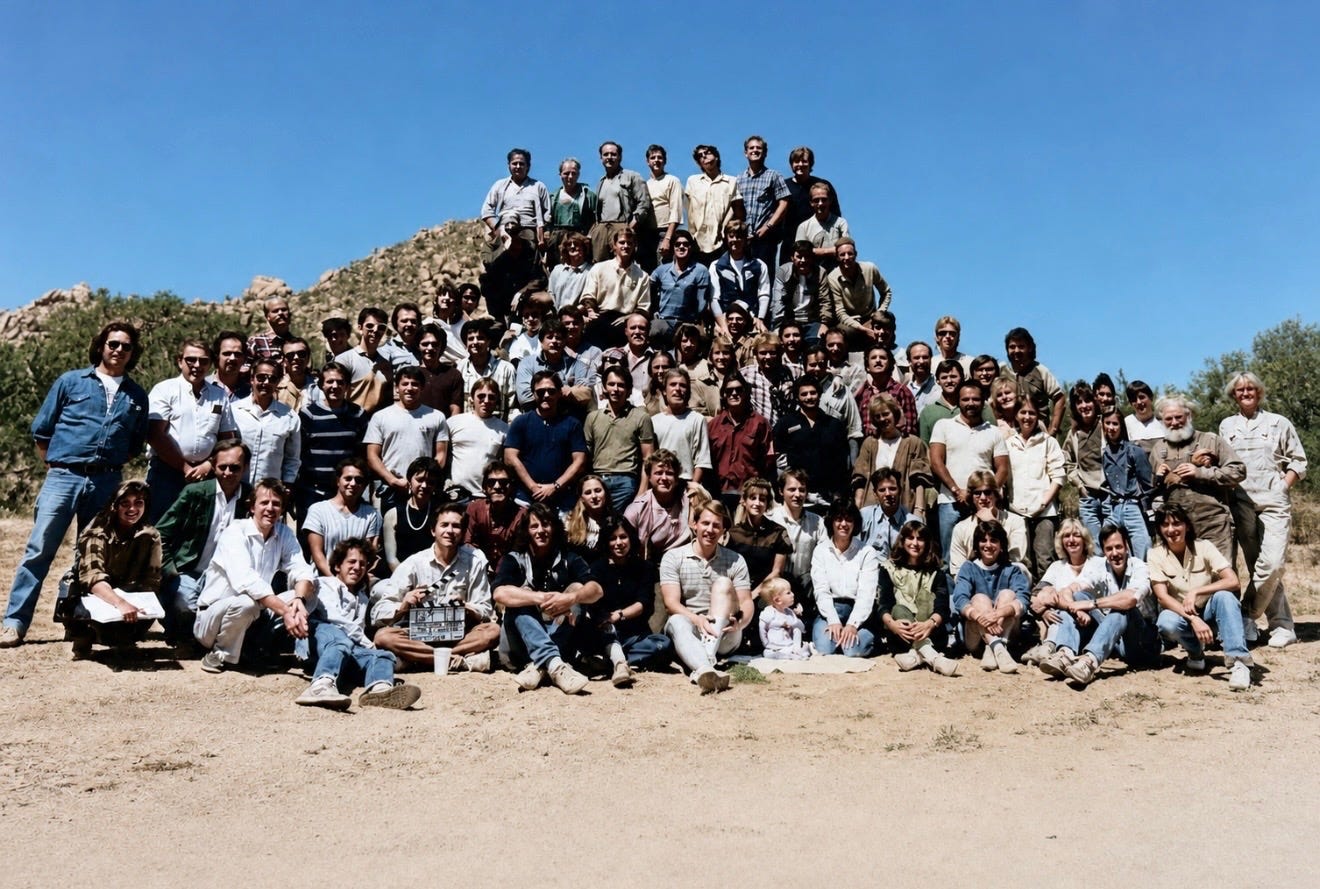
'The Raising Arizona cast and crew pose near Pinnacle Peak Patio, Scottsdale, early 1986. Provided by Julie Asch Smith.'
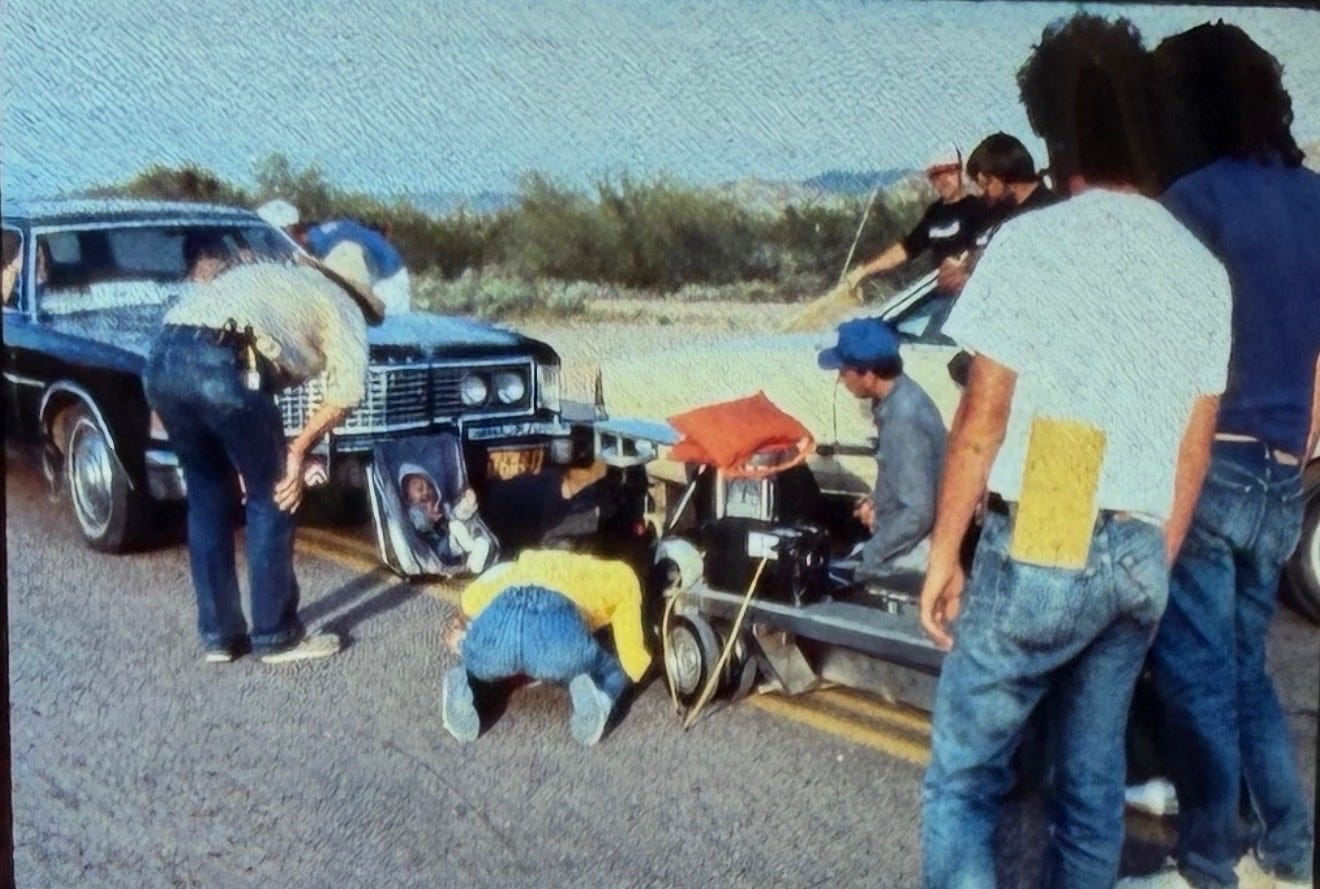
'T.J. Kuhn and Asch Smith, below left, settle in for the February 1986 Reata Pass shoot. Barry Sonnenfeld mans the camera. Provided by Julie Asch Smith.'
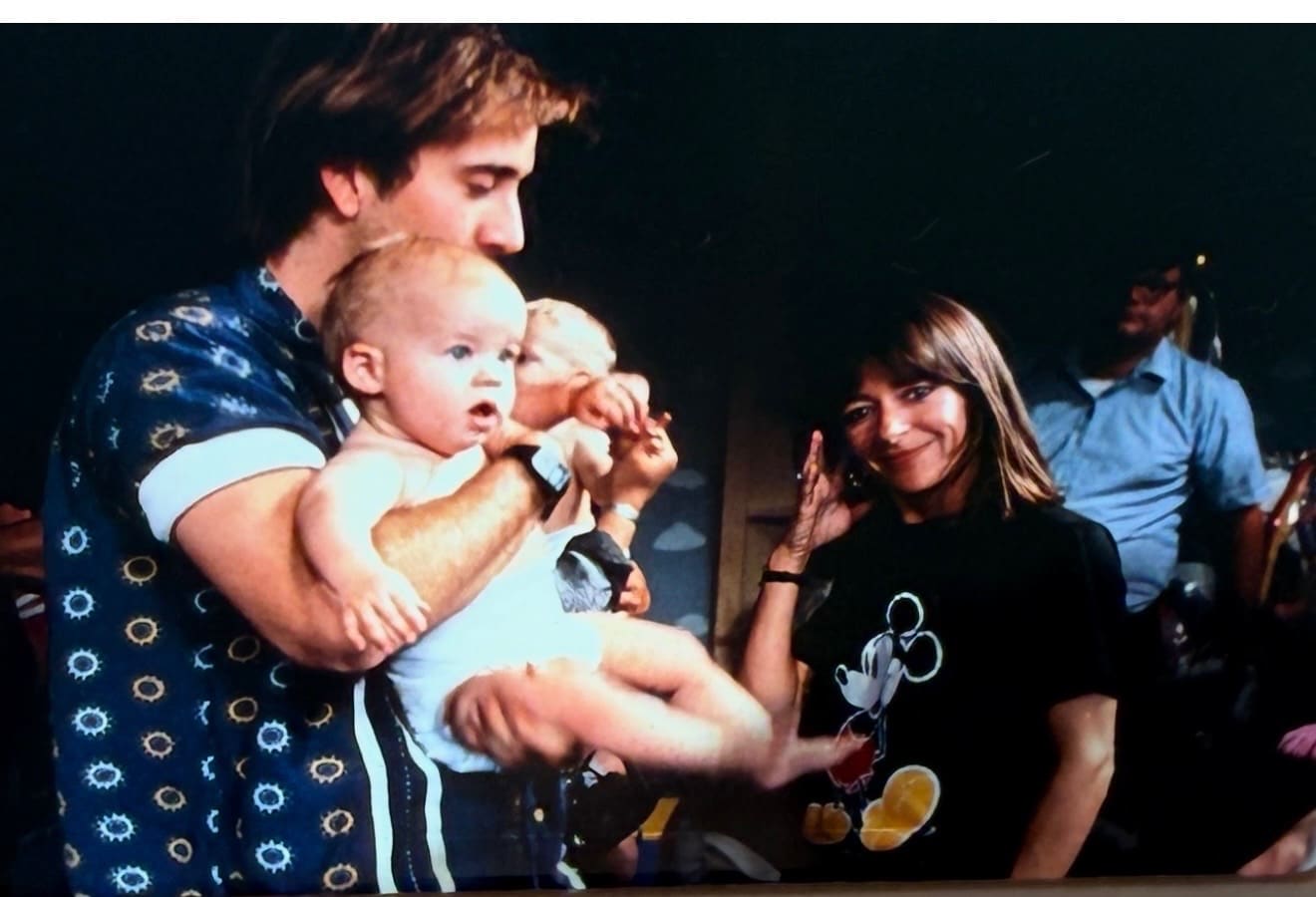
'Asch Smith, right, supervises Nicolas Cage on the Raising Arizona nursery set at Carefree Studios. Provided by Julie Asch Smith.'
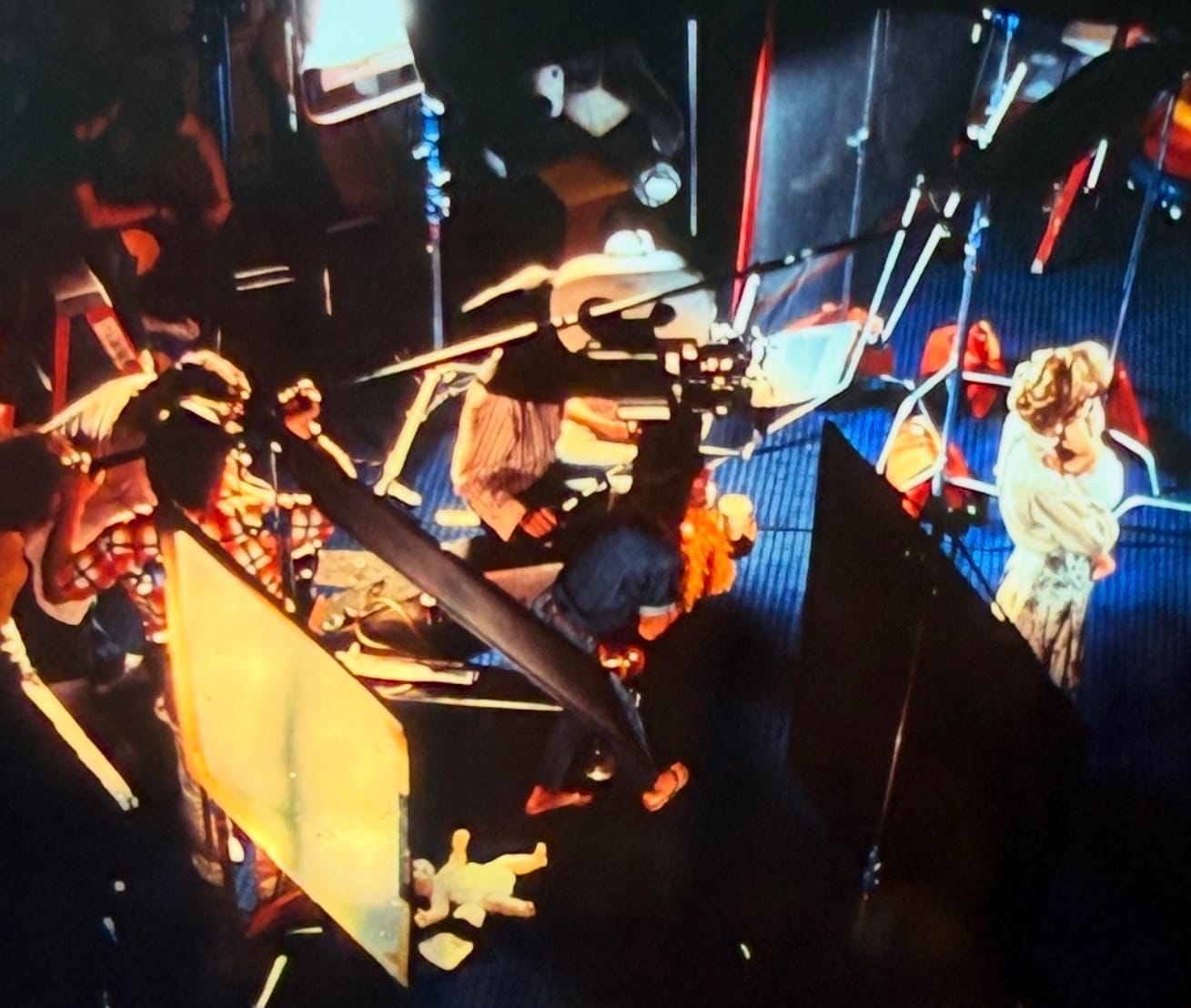
'Asch Smith, off- (but under) camera, engages T.J. in the comforting arms of Florence Arizona (Lynn Kitei). Provided by Julie Asch Smith.'
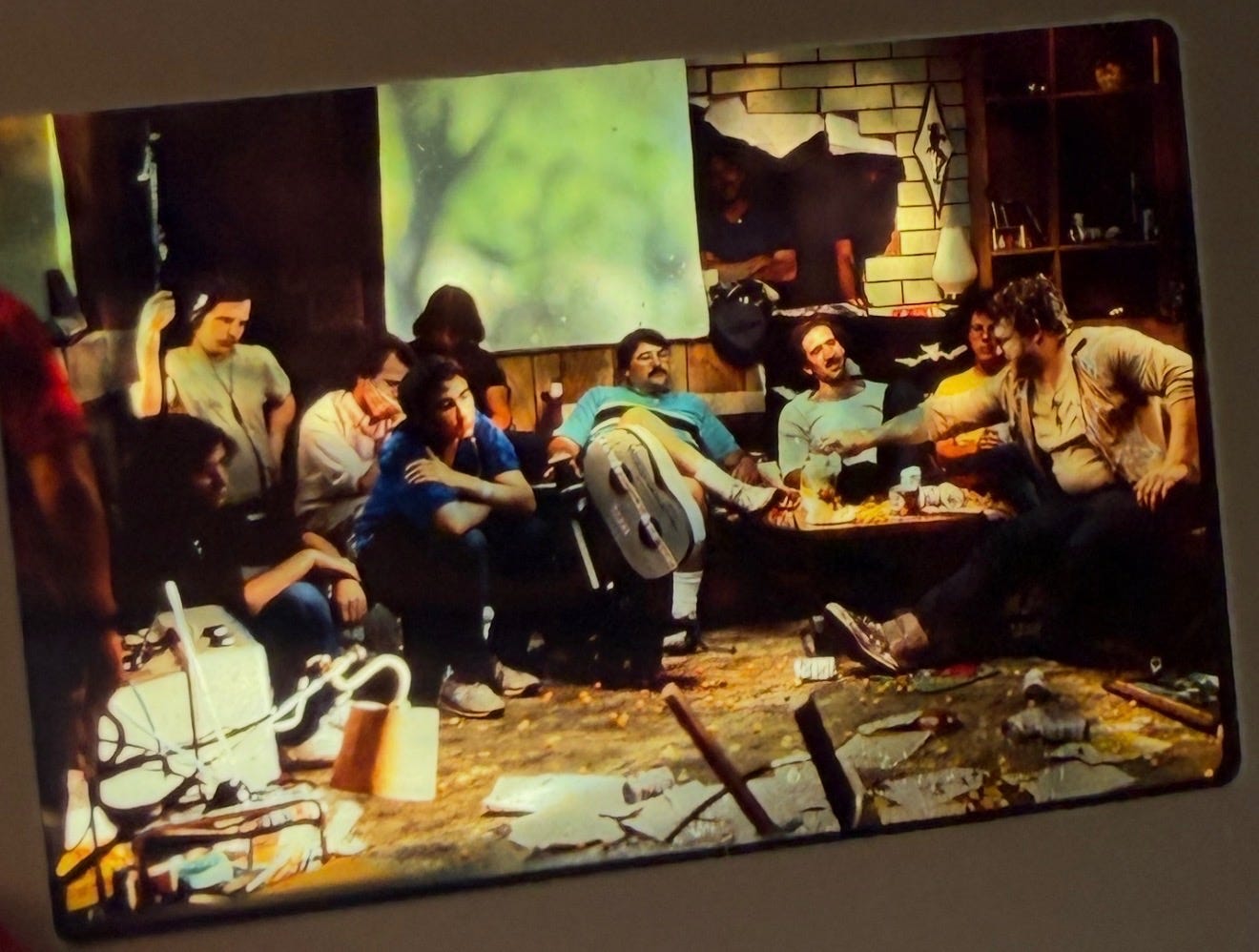
'Nicolas Cage, Ethan Coen, and John Goodman, all at right, confer with others following Raising Arizona’s trailer scuffle. Joel Coen sits on the floor at far left. Provided by Julie Asch Smith.'
END NOTE
- As an ’80s kid/cineaste whose cultural obsessions sometimes became pop history, I couldn’t resist asking about Ishtar, that alleged embarrassment, that talk-show punchline. Were there conceivable comparisons to be made between that disaster and Raising Arizona? After all, it did earn a berth within the esteemed Criterion Channel’s “Razzies” lineup. Was it due a reappraisal, too?
“People were writing about it months before it opened,” Dallago says, recalling an interview he did —anonymously — with New York contributing editor David Blum for the* *magazine’s withering March 16, 1987, cover story, “The Road to Ishtar.” “This was a case where people had doubts about whether the movie was good or not while they were shooting it. Ishtar came in at $40 million, which was astronomical then. Plus, a lot of people wanted to dislike Warren Beatty, who I think was incredibly miscast. He was so uncomfortable. It just had a bad reputation from the beginning.”
In short: No. (Interestingly, the New York in question features a full-page Raising Arizona ad.)
Special thanks to the American Film Institute; Arizona Film Commission; Arizona Daily Sun; Arizona Republic*; Phil Bradstock, Film Phoenix; Peter Catalanotte and Monica Lopez Guzman, Film Tucson; Rick Dallago; KD Forgia, Arizona Historical Society; Chris Frye; Richard Frye; Brandon Grady; William Hemstrom, Oregon State University (Jon Lewis, academic advisor); the Hilton North Scottsdale at Cavasson; The Hollywood Reporter; Rhonda Johnston; Debra Knoblauch; T.J. Kuhn; Tom Kuhn; Los Angeles Times; Danny MacCallum; Paula Martin; Poppy Martin; Michael Lee Nirenberg*; Phoenix New Times*; the City of Scottsdale; Linette Shorr; Julie Asch Smith; Christina Ward, Feral House; and Zia Records (Phoenix).*
Written from April to August 2026.
Please consider becoming a free or paid S+N subscriber.
Subscribe<div

