‘Arizona Sounds’: Chad Carnahan’s deep thoughts about the classic record compilations
Local radio station KDKB delivered the late ‘70s and early ‘80s vinyl and cassettes.
By Chad Carnahan
The Warning
Uh… Yeah… So…
Let’s sit down together and get clear before this gets underway. The songs on these records are some of the worst, most God-awful, wretched things you will ever audibly experience. I wish I could say that the music on these records was some great outsider art or cheesy, unaware type of hip thing that could make you laugh or be ironic in some kind of way, Ala Florence Foster Jenkins or whatnot. No, no, Jesus fuck no, this is pain. In so many ways, that’s what I find so beautiful: that there was a time that an AZ radio station would spend their money, their time, and their energy to produce records for bands and then graciously play those records on the radio to be heard in a home in Ajo, Arizona, or a tire store in Glendale, or my sister’s room in Chandler.
The details and documentation
The “Arizona Sounds” compilation LP series was a hallmark of KDKB (93.3 FM) in the late 1970s and early 1980s, serving as a vital showcase for local Arizona underground, rock, folk, and country-rock talent.
While the station itself was steered by legendary freeform architects like Bill Compton (who shaped KDKB’s defining sound and taste as music director and afternoon-drive host) alongside station founders Dwight Tindle and Eric Hauenstein, the specific personnel and executive forces behind the Arizona Sounds record series credits varied across the releases:
Jon Sinton: A pivotal figure in the station’s orbit who handled executive production, coordination, and contributed liner notes for volumes like Volume III.
Jeff Sattler and Tommy Vascocu: Listed as executive producers on later installments in the series (such as Volume IV and Volume V released in 1980 and 1981 under Mesa Radio, Inc.).
Local Engineers & Studios: The tracks were captured across a patchwork of local and regional recording spaces integral to the era’s desert scene, featuring engineering contributions from figures like Sandy Lamont, Jim Waldon, and Ed Ravenscroft.
The series famously platformed dozens of foundational Arizona acts, including Hans Olson, Joe Bethancourt, Shep Cooke, The Bob Meighan Band, and George Gilman, giving permanent vinyl life to the vibrant local scene that KDKB championed on the airwaves.
The thank-you & the challenge
It Cobains my mind and brings me to tears that it used to be like this. It should still be like this, but sadly, it is not. The worst part is, we all know why music no longer works this way. “The answer to all your questions is money.” This quote is credited to Don Ohlmeyer, a late NBC television executive and producer. Try saying it sometime during any conversation; you will be disgusted by how often it applies.
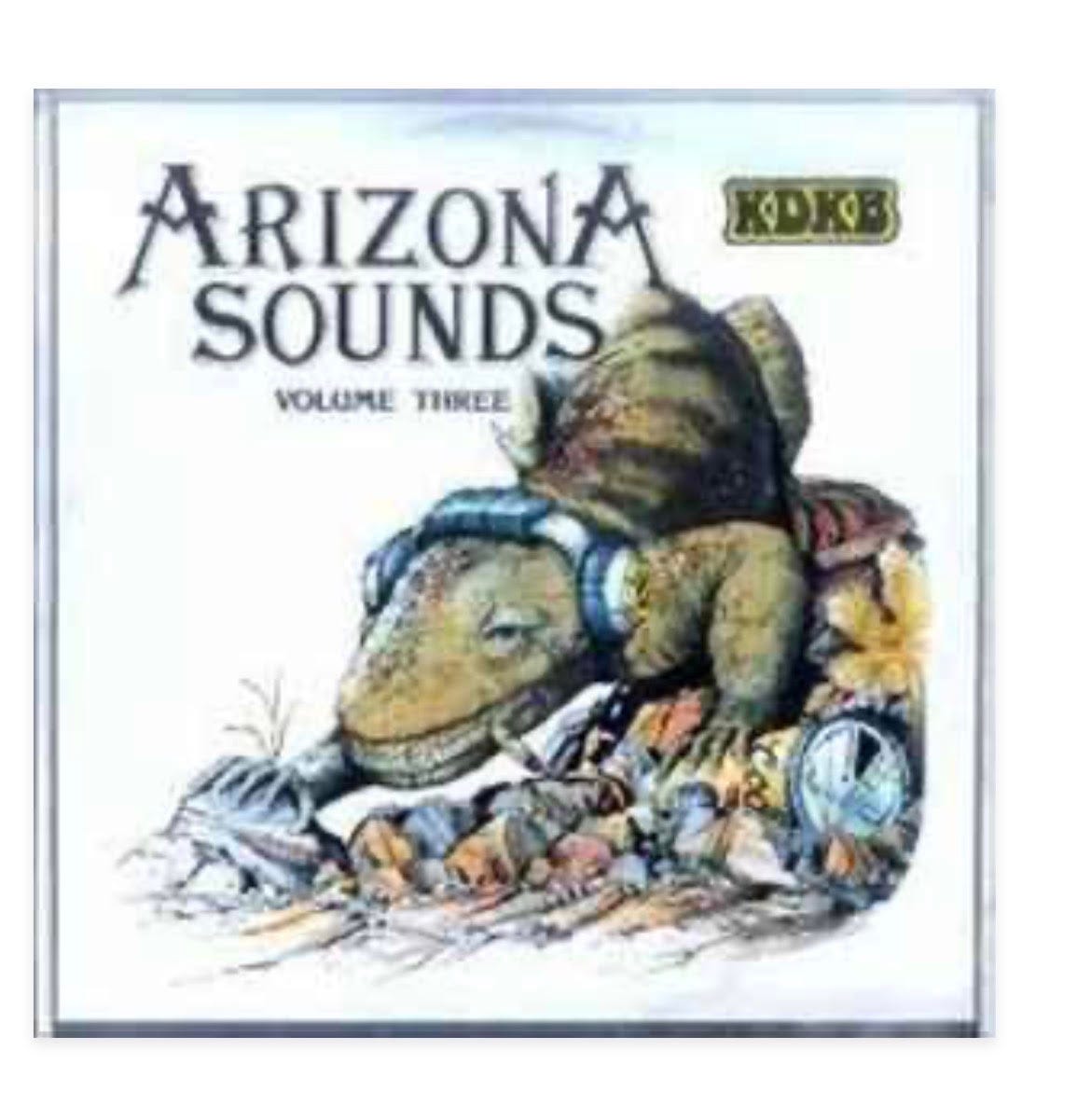
So let’s talk about the kind of local Arizona music history that doesn’t make it into a New Times retrospective or an Instagram AZ archive page. These are the kinds of records you dig out of a milk crate at a yard sale in Apache Junction, or, in my case, ask your sister to put on because a cool lizard is on the cover and you are six years old.
Back in the 1970s and early ‘80s, when FM radio was not just a soulless corporate algorithm up-chucking approved classic rock hits, KDKB was the heartbeat of the Valley. And nothing captured the weird, tube floating, meth-baked chaos of our local scene quite like the Arizona Sounds compilation series.
Why did they do it? Simple: KDKB wasn’t just playing music; they were building a community out of the local dirt. In an era before the internet, local bands were shouting into a void, trying to get noticed in a flyover state that corporate record executives mostly ignored. KDKB, operating with a bearded, renegade, and freeform spirit, decided to bridge the gap. They weren’t beholden to rigid national playlists, so they threw open their doors, invited the local “talent” into the studio, culled through hundreds of raw reel-to-reel band tapes, and pressed these vinyl artifacts into existence. It was a middle finger to the coasts and a love letter to the Valley, an absolute declaration that Arizona had its own sound, its own pulse, and its own weird and generic secondhand identity.
If you grew up around here, these records were sacred scars. They proved that beneath the asphalt summer, a whole ecosystem of L.A. rejected freaks, fried folkies, half-hearted punks, and dehydrated cowboys were plugging in and making music.
Volume One (1977): The Gaseous Cowboy Collection
The series kicked off in 1977, as the Valley was swimming in a putrid cocktail of country-rock and desert stink, giving a phallic megaphone to artists who otherwise existed only in smoky local bars.
Early Peas set the tone right out of the gate with “Long Day,” a track that felt like crawling out of a urine-soaked tent in Flagstaff with a hangover.
Custer’s Last Band followed with “Crazy Bass,” proving that a hi-hat can comfortably be the loudest sound in a mix. You also had folk troubadour Shep Cooke spinning tales on “Roller Coaster Ride,” the ever-beloved Bob Meighan Band with “From Who,” and Joe Bethancourt warning us all about “Snakes & Cactus.”
Side two sucks just as bad, featuring Duane Davenport with “The North Of Arizona,” The Normal Brothers tackling “Fiddler & The Gambler,” blues master Hans Olson laying down raw grit on “Early In The Morning,” and the legendary Dusty Chaps telling folks to “Keep Your Hands Off Her Stranger (She’s With Me).”
Rounding it out were The Fabulous Air Brothers with “No Regrets” and Fester Plugg & The Stilt Chickens sealing the weirdness with “Stilt Chicken’s Theme Song.” I do love this track; it has an unintentional Residents vibe to me. It was homespun, unpolished, and entirely AZ.
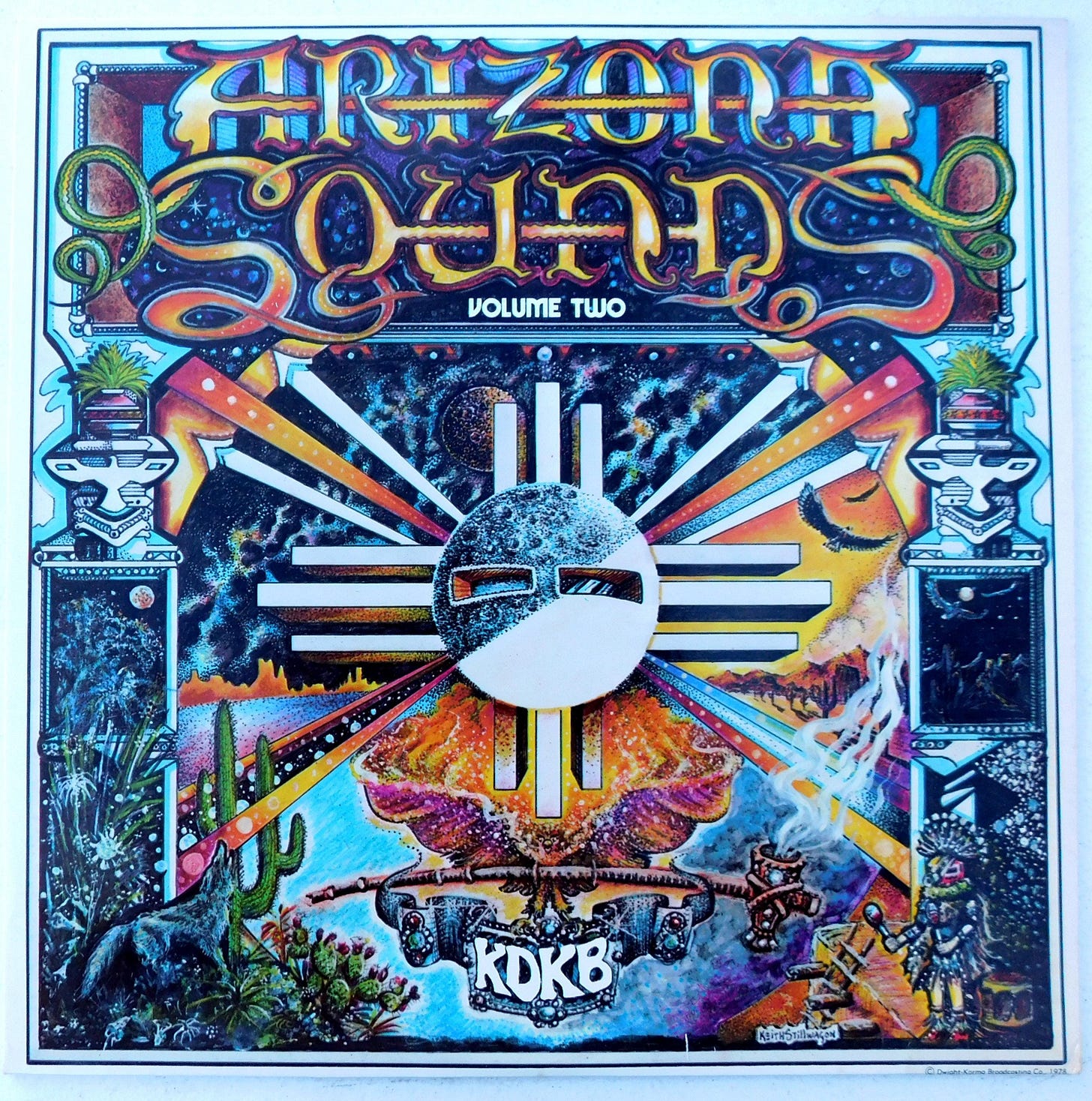
Volume Two (1978): The Folk and Rock Shit
By 1978, the state was shifting, and Arizona Sounds Volume Two widened the lens, capturing a broader snapshot of local river rock troubadours and garbage-bound dreamers as KDKB doubled down on documenting the underground before it evaporated.
The Clones brought a beautiful slab of cultural appropriation with “Banana King,” while Beggs ‘N Aitken offered up one of the worst songs you’ll ever hear, “I Found Love In Front Of My Face.”
The record takes a positive, cheese jazz turn with Mark Murdock and Matt Niskern on “Seacloud” and Tom Previte and Keny Francis on “On My Mind.”
Lightnin’ Stock made you want to pack your bags and never come home with “Fly Me Back To Tucson,” and Trout Fishing In America brought a great intro, followed by hot garbage, on “High In The Highlands.”
The flip side keeps the gun in your mouth with Valley Fever chugging through “Can’t Let Go,” Wolfgang getting moody on “Cynthia,” Faux Päs kicking up poop with “Whiskey,” Barbara Hink delivering vocal cringe on “Can’t Hold Back.” Reed Garner thankfully closing shop with the clever narrative of “The Sticker Song.”
Volume Three (1979): The New Wave Miss
By 1979, the guitar-pull era was fraying at the edges, replaced by the twitchy, caffeinated energy of impending new wave and tighter rock arrangements—and KDKB was there to capture the mutation in real time.
Loosely Tight opened side one with the dog shit offering “Rough ‘N Tough,” followed by Atrox and the “God I hope I die soon” vocals of Jennifer Brant on “See The Light.”
Jim Moorhous dropped the shart-like power-poop gem “See You At the Party,” while The Now gloriously failed at capturing the nervous, synthesizer-laden spirit of the upcoming decade with “Record Deal.”
Whitenoise delivered a hot steaming pile of harmonica-driven dung on “H.D. Boogie,” and Billy Clone & The Same brought fart-damaged theatricality to “Don’t Look Back.”
Side two featured the smooth and forgettable craftsmanship of Booth, Davis & Lowe on “I Should Know You,” Llory McDonald pulled out on “Something For Nothing,” and Justin Tyme getting quirky with anal kazoos and acoustic strings on “Takin’ It Easy.”
Fast Eddie pushed the tempo with “Time To Get Loose,” Stephan Shawn poured his plastic heart into “Dream On Dreamer,” and the compilation went out on a hilariously chaotic note with Nurl Fartley & The Original Fartones performing “Saddle On The Stove.” Because if you did not think this was bad enough yet, how about some 1970s humor in the background as you try to eat yourself alive.
Volume V (1981): The Discard-Rock and Glam Pork Belly
Skipping cleanly into the new decade, 1981’s Arizona Sounds Volume V proved that KDKB’s mission hadn’t sputtered out. This volume traded some of the old folk-circle coziness for a sharper, heavier, and even more generic rock bite, reflecting a younger generation plugging into high-gain amplifiers and then turning them down and trying to play as typically as possible.
The Marty Mitchell Band kicked the door and hurt their foot with “Damned If You Do,” trading in big saxophone hooks and driving rhythms.
Tempest leaned hard into melodic metal majesty on “Modern Love,” while Doug Doehrman offered a reflective counter-balance with the Laurel Canyon-esque acoustic meditation “What Am I To Do.”
Captain Tripps took us on a psychedelic detour with “Dead ‘N Gone,” and fuck how I wish I were. The Two Week Notice Band brought heavy pedal steel and twang to “Heaven’s On Fire.”
One of the compilation's absolute crown jewels arrived right before the flip: The School Boys dropping the razor-sharp power pop of “Dagger And A Kiss.”
Side two kept the momentum roaring with Dirty Pearl cruising down the strip on “Custom Caddie,” Bill Clifford opening things up on “Open Up,” and the M & M Band grooving through “I Don’t Mind.”
Rounding out the journey were Jim Allen and The Sweetbriar Band with “Love’s What I Give,” Freeze executing a brilliant keyboard-and-guitar interplay on “Squeeze Play,” and Rampage kitchen-sinking the finale with flutes, clarinets, and unbridled enthusiasm on “Give It Your All.”
Looking back, these records weren’t just promotional tools or tax write-offs for an FM radio station. They were an act of preservation. KDKB gave a voice to the underdogs, ensuring that the sweat, amplifiers, and dreams poured into local stages wouldn’t just vanish into the desert air.
Now, if you don’t mind, I’m going to slip on some worn-in denim, drop a needle on side one, lightly put a shotgun in my mouth, and imagine what the neon lights of central Phoenix looked like fifty years ago as I pull the trigger.
Just in case you hate yourself, here go
Arizona Sounds Volume 3 - Compilation - (KDKB - 1979)
This rare vintage upload lets you directly hear the exact needle drops and quirky underground tracks featured on the 1979 KDKB compilation discussed above**.**
_**About Chad: **_Chad Carnahan is a musician from Chandler, Arizona. He has been making art, poetry, and food in the Phoenix area since the 1980’s. His band The Vinegar Sting has been annoying people off and on for the last 26 years. His solo project Bombing of Naco has 204 people in it. His art can only be seen by accident, and his poetry is composed only of numbers. Several valley restaurants and hotels serve his tasty culinary creations.

