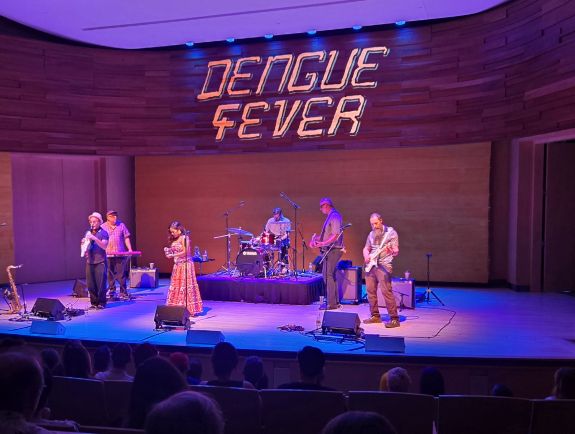
Photo: Dengue Fever at the MIM by Jaime Paul Lamb.
The Ghosts of Phnom Penh: Dengue Fever live at the Musical Instrument Museum
Jaime Paul Lamb on why the August 9 show was completely "magnificent," and a historical precursor.
By Jaime Paul Lamb
Prologue
In the early aughts, while living in Los Angeles, I intermittently participated in a long-running radio and online streaming project called the Mannlicher Carcano Radio Hour. It was a sound collage collective that started in Winnipeg, Manitoba, way back in 1987. The Echo Park colony of the MCRH was established by Canadian expat Doug Harvey, the lead art critic for the LA Weekly at that time.
Doug was about as hip as you could get — not in the obnoxious sense of the term. What I mean is that he had impeccable taste in general (visual arts, music, literature, cinema, whatever) and he had his finger right on the cultural pulse. I was over at his studio one Saturday at 11:00 AM, which is when he'd get online with the Canadians to record that week's program. Usually, I'd hang out with Doug for a bit after the show, and he'd curate his latest finds for me in various media.
One week in 2005, he was particularly excited about a CD he had recently bought. It was a compilation of cassette-recorded radio captures presented as a sound collage, featuring gorgeous, high-saturation, full-bleed cover and insert art. It was called Radio Phnom Penh (2005, Sublime Frequencies SF 020), and it blew my mind. All Doug told me was that some guy was traveling around Cambodia dubbing tunes he caught on the airwaves to cassette — just the sort of punk documentarianism I like — a cocktail of obscure exotica and cultural voyeurism. Doug burned me a copy of the CD that afternoon (sorry Alan & Hisham! I ended up actually purchasing a copy later so I could have the artwork) and I've been hooked ever since.
What is Khmer Pop?
That was my introduction to pre-Khmer Rouge Cambodian pop music, and it was all I wanted to listen to for about a year. In fact, some years later, my wife and I spent a couple of weeks in the country, mostly traveling between Phnom Penh and Krong Siem Reap — and I came home with almost too many cassettes and CDs (not a lot of vinyl there, and the format doesn't travel quite as easily).
This older species of Khmer Pop—often referred to as the "Golden Age" of the genre—is an infectious and highly addictive musical fusion wherein Western idioms such as '60s surf, garage punk, pop, and psych form the harmonic, rhythmic, and stylistic foundation. But the element that differentiates it from its Western prototype is the largely pentatonic, somewhat microtonal, and highly ornamented vocal melodizing, accented by the occasional flourish of Southeast Asian percussion. Because the melodies are almost always pentatonic (modal scales consisting of five notes), the only chord changes necessary to support the melodies are a handful of relatively simple major and minor triads built from the scale tones. This allows for a certain folk simplicity with a surprising mercurial emotive range, passing easily from bright and pleasant to plaintive and melancholic.
The Khmer Rouge and the Cambodian Genocide
Throughout the '60s and '70s, the music flourished. Artists such as Sinn Sisamouth, Ros Serey Sothea, and Pen Ran ruled the airwaves amid a scene that could have easily rivaled San Francisco or London at the time in its momentum and optimism. But sadly, this all came to an abrupt end when, after years of civil war, Phnom Penh fell to Pol Pot's brutal Communist regime, the Khmer Rouge (The Communist Party of Democratic Kampuchea, 1975–1979, whose motto was: "To destroy you is no loss; to preserve you is no gain." Isn't that nice?).
The city's inhabitants were forced, at the barrel of a gun, out of their urban dwellings and straight into the fields where — if they survived the march — they were forced to toil in the countryside, far away from the lives they had known, to achieve the regime's agrarian socialist vision. With the population cleansed of any degenerate "Westernisms" such as radios, books, or eyeglasses, the regime's "Year Zero" had begun.
Estimates say that 90% of all Cambodian artists, musicians, and intellectuals were killed during Pol Pot's genocidal campaign.
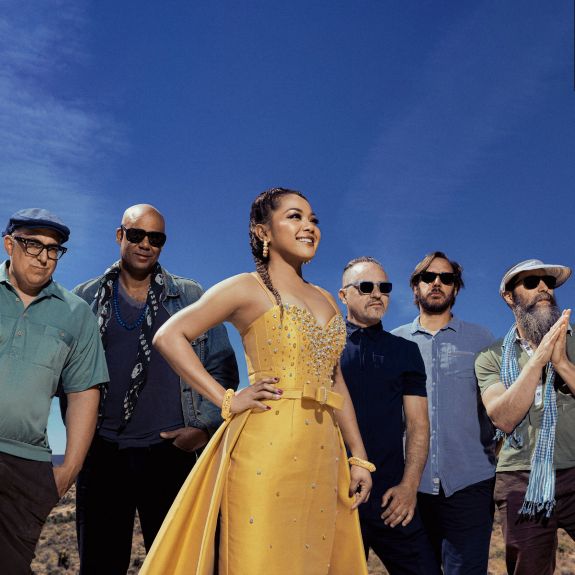
Dengue Fever
A few years before Doug Harvey turned me on to Khmer Pop, brothers Ethan and Zac Holzman had also caught the bug and decided to form a band. Obsessed with the music, and also residing in the LA basin, they scoured Long Beach's "Little Phnom Penh" looking for a chanteuse. They had the incredibly good fortune of catching a set by the singer Chhom Nimol, who had enjoyed some success as a singer back in Cambodia and even performed for the Royal Family there. A recent arrival to the States, Nimol had been singing in local Cambodian nightclubs when the Holzman brothers discovered her.
Rounding out the lineup with bassist Senon Williams, flutist/saxophonist David Ralicke, and drummer/percussionist Paul Smith, Dengue Fever was born in 2001.
Since then, they have released six LPs, four EPs, a live recording, and a soundtrack. Their music has also been featured heavily in television and film.
Live at the Musical Instrument Museum
On the evening of Sunday, August 9th, 2026, at about 7:00 PM, Dengue Fever took the stage at the Musical Instrument Museum in Phoenix and proceeded to play a magnificent one-and-a-half-hour set. The Music Theater at the MIM is one of my top three favorite venues for live music, ever. It is seriously a world-class listening room. It sounds amazing, and you have an unobstructed view from pretty much anywhere in the house. If you've never been, look for something you like in their upcoming concert lineup.
I only noticed about three cover songs in their set. I'm pretty conversant with the material, so I don't think many would get by me unless they were never included on the major compilations or in my personal cassette collection. For better or worse, they didn't lean too heavily on the stuff you hear on the Sublime Frequencies compilations (the aforementioned Radio Phnom Penh, Cambodian Cassette Archives, etc.) or the earlier Cambodian Rocks (1996, Parallel World).
A few of Dengue Fever's originals were either bilingual or fully in English. Personally, I prefer the ones sung completely in Cambodian because, frankly, the English lyrics I was able to make out were a bit corny. Besides, I like music in languages I don't understand so I don't have to process it in the left hemisphere. That way I can read or write while listening to it as comfortably as I can to jazz or European concert music. English lyrics are a bit of a distraction.
Their set was beautifully crafted, alternating keys and tempos to create dynamic peaks and valleys. The saxophonist, David Ralicke, did a particularly great job handling crowd interaction throughout the set. There was actually more variation than I was expecting, though all the tunes were — for the most part — faithfully rendered in the Cambodian style, melodically and rhythmically.
It's funny how that works: once you learn the contours of a specific genre of music, you can start to speak that language convincingly. But it takes time. At first, it may sound derivative or imitative. Still, over time, after the stylistic peculiarities and technical nuances are fully integrated, you become fluent, able to communicate freely within the idiom.
Apart from Nimol — a native Cambodian born with the context surrounding the music, culturally in situ — the other members, being Westerners, had a lot of listening and living to do before they could truly access the form and communicate fluently in that musical language. Of course the bare bones — American garage, psych, and pop— would come naturally to the Californians, but there's something unique about the Southeast Asian approach. Dengue Fever sounds completely natural and confident, which is what you want. Self-consciousness is a vibe killer in performance.
All that being said, Dengue Fever doesn't fit as neatly into the Khmer Pop box as they did at the beginning of their career. They sound today like a band that has come into its own. Whereas they may have started with the initial intention of approximating Sinn, Ros, and other "Golden Age" artists from the '60s and '70s, they have acclimated to the genre to such an extent that they are now able to authentically be themselves inside of it, without trying too hard, which is great because there's nothing worse than inauthenticity in music.
About Jaime:
Traditional astrologer, cartomancer, occultist, musician, and author in Phoenix, AZ. Visit jaimepaullamb.com and subscribe to his Substack here.
About the Author
Jaime Paul Lamb
Traditional astrologer, cartomancer, occultist, musician, and author in Phoenix, AZ. Visit jaimepaullamb.com and subscribe to his Substack.

