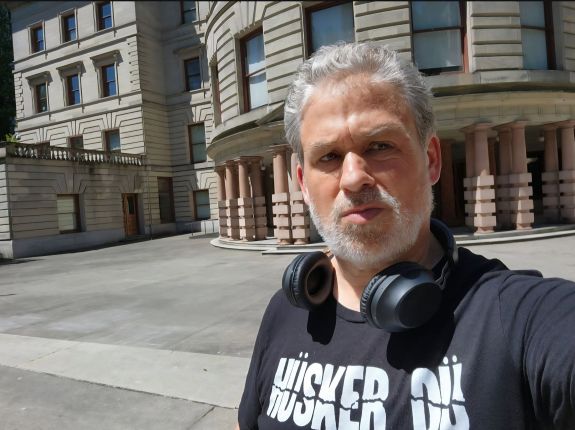
Photo: Cory Frye
Five on Friday: Cory Frye, award-winning journalist
One of these creations this writer treasures is not like the others.
By Cory Frye
Signal and Noise thanks Cory for contributing to our weekly column. Here, he wastes no time getting to his list:
‘Jessica’s Bra’ by Deep Purple
Earlier this week, pomp o’ dour riff-ripper Ritchie Blackmore joined his old mates for the first time since storming offstage — presumably forever — during the Battle Rages On tour in ’93. He shadow-dueled current guitarist Simon McBride and vocalist/ex-sparring partner Ian Gillan to stamp “Smoke on the Water,” the FM perennial he’d birthed into the zeitgeist, with a senior coconspirator’s authenticity.
Sweet though the reunion was, his band improved tremendously when he left, snatching Steve Morse from Kansas and The Dixie Dregs for a 27-year ride, from Purpendicular (1994) to Turning to Crime (2021). Last month, it issued Album No. 24, SPLAT!, continuing an inspired titling run that’s included Bananas (2003), Now What?! (2013), Whoosh! (2020), and =1 (2022).
“Jessica’s Bra” ranks as an excellent example of the Purps’ comedic and oft-juvenile ribaldry, a story-song indulgence it’s practiced since at least 1987’s “Mitzi Dupree” (House of Blue Light), whose content we’re wisely advised to skip.
About neither a woman nor her undergarments, though entendres suggest otherwise, “Jessica’s Bra” refers to a misspelled bar sign over the spot’s regulars, kinda like a “Piano Man” set somewhere in Denmark with Don Airey, not Billy Joel, overlording the keys — here, that trademark Hammond dancing wild jigs over Martin chugs between Ian Gillan commentary. We never learn who Jessica was, but we know to keep clear of Big Mary. May we all have such fun in our twilight.
‘I Married Myself’ by Sparks
I succumbed to the Mael brothers — one sans mustache, the other’s post-Chaplin burrito brush historically alarming — during a paleolithic SNL hosted by Danny DeVito shortly after Taxi’s cancellation. They played, I reckon, “Mickey Mouse” and “I Predict” from the then-new Angst in My Pants LP. I was 9, maybe 10, the perfect age to embrace such music. C’mon, who wouldn’t be charmed by “Cold beer and pretzels takes care of cancer”?
All these years later, they’ve remained remarkably sharp and consistent. (Shout-outs to “Please Don’t Fuck Up My World” and “Nothing Is as Good as They Say It Is” over the last decade.) My favorite disc this millennium, however, has been 2002’s Li’l Beethoven, in which they deliberately restrict themselves to loops, as announced on “Rhythm Thief” and maintained to the end. “I Married Myself” is both silly and gorgeous, a repetitive paean to satisfied loneliness amplified by Ron Mael’s stout organ falls and Russell’s Lennon-esque yearnings for the truest of loves.
‘Choctaw Bingo’ by Ray Wylie Hubbard
James McMurtry wrote and performed it first, but, man, it sounds natural rolling out Hubbard’s whiskey-wet throat, 10 zillion tales a-wanderin’ and hoping to connect before rounding back to “Where was I?” Just like McMurtry as he fit its pieces during long, quiet drives to and from Oklahoma, full of sights you could pass only on roads to elsewhere.
Ray’s been name-dropping from porches since time began, throwing everyone and everything from The Alarm and Hell’s Angel Sonny Barger to random guitar parts into his repertoire. (There’s also that great album title, 2010’s A. Enlightenment, B. Endarkenment (Hint: There Is No C).) Onstage, he unloads stories full of folks like J.J. Cale and that one guy he always encounters in the men’s room who demands he play “Up Against the Wall, Redneck Mother,” made famous by Jerry Jeff Walker on 1973’s ¡Viva Terlingua!, the most satisfying live country disc you’ll likely know.
“Choctaw Bingo” never names its narrator, but for eight solid minutes he disparages his kin, who he simultaneously loves and sometimes fears. He even harbors unspeakable thoughts, so let’s speak not of those cousins. All are developed with a novelist’s depth in nonrhyming run-on testimonials (long, Kerouac-ian sentences where the verb’s just a speck from the direct object) and stuffed between hopeless landscapes usually witnessed from a freeway’s distance.
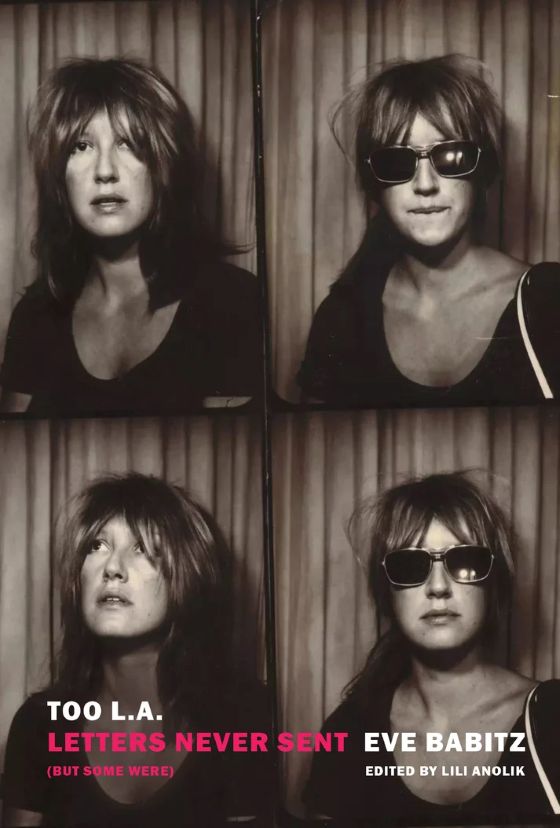
Eve Babitz, Too L.A. (New York Review Books, 2026)
Remember the spring of Oliver Stone’s The Doors (1991), when every 19-year-old grew his nicked Vanilla Ice eyebrows back to become a shaman poet? I was one of those cats ’til I read Eve Babitz’s humanization of the Morrison mystique in that March’s Esquire. Most writers lionized Jim in Aquarian hagiography. Eve knew him, liked him, fucked him, yet made him fallible, directionless, confused. “Jim was embarrassing because he wasn’t cool,” she wrote, adding later, “By the time [he] left L.A. everyone thought he was a fool. … He didn’t have enough ideas in his head to keep people interested any longer. Underneath his mask, he was dead. But then, by 1971, who wasn’t?”
As writers, Eve and Joan Didion — friends and enemies — have represented Southern California to me forever. When I moved back to my home state in 2000, my editor gave me a copy of Didion’s The White Album, which seemed as freeway-necessary as the Thomas Guide. Can’t remember how I found the Babitz bounty; was it the Borders near Hollywood and Vine? But her Eve’s Hollywood was the Stones’ “Monkey Man” to Didion’s “Paperback Writer.” Her work’s stuck with me. Not that Joan’s hasn’t and can’t, but she’s not ingrained as deep. It’s like comparing Erma Bombeck to Dorothy Parker.
Author Lili Anolik has worked diligently to keep the Babitz name alive. She spent time with the woman in question and survived to write Hollywood’s Eve: Eve Babitz and the Secret History of L.A. (Scribner, 2019), then returned for Didion & Babitz (Atlantic, 2024). Now she’s collected the woman’s correspondence into the vital *Too L.A.: Letters Never Sent (But Some Were) *(New York Review Books, 2026). I haven’t read any truly great compendiums like this, ’cept maybe Shirley Jackson’s. Her personality burns down every page, intimidating, hilarious, alive, resurrecting cities and personalities that vanished long ago.
Her like is missed. She is missed. May Lili resurrect her voice forever.
‘Faded’ by The Afghan Whigs
Albany, Oregon, still had hacked lungs past winter when I bought Black Love in March ’96. Only Phonomania downtown sold it, the perfect atmosphere, air thick with incense and Stereolab, one narrow scar through discovery. I can’t imagine a more ’90s album, or at least one that dragged me through a valuable life detour, when I attended local shows every weekend, worked a job I despised, ate exclusively at 7-Eleven, and lived in a part of the city reserved for shitkickers, layabouts, and starving dreamers, where police cars often stopped.
Every night, I’d kill my studio-apartment lights, spark a cheap veladora, and conjure novels I knew would get me the fuck out, all while grooving to “Crime Scene, Part One,” “Blame, Etc.,” “Going to Town,” “Bulletproof,” and, of course, “Night by Candlelight” and “Summer’s Kiss.” Greg Dulli sang what I felt in words I could not articulate: a love I wasn’t authorized to feel. I was the Black Love guy, and “Faded” was my anthem, Rick McCollum’s wah-wah wallow calling in from church-of-the-dark-soul LPs — an influence one rarely heard in those days. “Lord, lift me out of the night,” Dulli prayed in anguish. “Come on, look down / and see the mess I’m in tonight.” It was triumph and defeat in one beautiful cataclysm that should have ended not only Black Love, but every record ever made.
I should add that I later worked with The Afghan Whigs, riding sidecar as Dulli and bassist John Curley curated *Unbreakable: A Retrospective (1990-2007) during the band’s long *limbo, reuniting the core at Memphis’ Ardent Studios for two new songs. That disc ended with “Faded,” too. It had no choice.
I followed Greg through the Twilight Singers and Gutter Twins and then back to the Whigs, who surprised me with a new album, Do to the Beast (2014), that sounded as if the band had never splintered, evolving in secret all along. In Spades (2017) fucked with me hard. How Do You Burn? (2022) shot me into space. By the time you read this, Soft Control (2026) may have buried me in the cold, hot earth.
About Cory:
Cory Frye is a Society of Professional Journalists and Oregon Newspaper Publishers Association award-winning writer and editor whose work since 1991 has appeared, variously, in the Oregonian (Portland, OR), the Albany Democrat-Herald (Albany, OR), Corvallis Gazette-Times (Corvallis, OR), Maggot Brain, Under the Radar, Hit List, Yahoo! Music and the Rock & Roll Hall of Fame. From 2000 to 2007, he was a writer, researcher, and editor for the Rhino Entertainment record label in Los Angeles (for whom he still works when asked), where he even co-produced a pair of releases: the deliriously slaughtered Whatever: The ’90s Pop & Culture Box (2005) and the better-acclaimed Afghan Whigs career compendium, Unbreakable: A Retrospective (2007). In 2015, he published his first book, Murder in Linn County, Oregon: The True Story of the Legendary Plainview Killings (Arcadia Publishing/The History Press), which explored the 1922-23 deaths of two area sheriffs. His second, an in-depth biography of the Rowan & Martin comedy team, is planned for 2027.
About the Author
Cory Frye
Cory Frye is a Society of Professional Journalists and Oregon Newspaper Publishers Association award-winning writer and editor whose work since 1991 has appeared in the Oregonian, Albany Democrat-Herald, Corvallis Gazette-Times, Maggot Brain, Under the Radar, Hit List, Yahoo! Music and the Rock & Roll Hall of Fame. From 2000 to 2007, he was a writer, researcher, and editor for the Rhino Entertainment record label in Los Angeles. In 2015, he published his first book, Murder in Linn County, Oregon: The True Story of the Legendary Plainview Killings. His second, an in-depth biography of the Rowan & Martin comedy team, is planned for 2027.
More from this column
- Five on Friday: Protomartyr’s Joe CaseyOctober 9, 2026
- Five on Friday: Comedian and writer Anwar NewtonSeptember 18, 2026
- Five on Friday: Hey, It's Kepi Ghoulie!August 28, 2026
- Amor Y Powers heads out for a round of West Coast showsAugust 25, 2026
- Five on Friday: Iconic and groovy, it's Kid Congo PowersAugust 21, 2026
- Five on Friday: Sharon Labor (Thee Oblidiots, Labor Party, MonkeyCat + more)July 31, 2026
- Five on Friday: Michael Cornelius (JFA, Jr. Chemists, Father Figures + more)July 24, 2026
- Five on Friday: Songs that taught me to surviveJuly 17, 2026
- Five on Friday: Author and musician Jaime Paul LambJune 12, 2026
- Five on Friday: Kronerson speaksMay 29, 2026
- Five on Friday: Christina Ward of Feral HouseMay 1, 2026

