Photo: Photo by Cory Frye
Under the microscope: 'Classic Rock 1966-1988'
Cory Frye dissects the four-volume set.
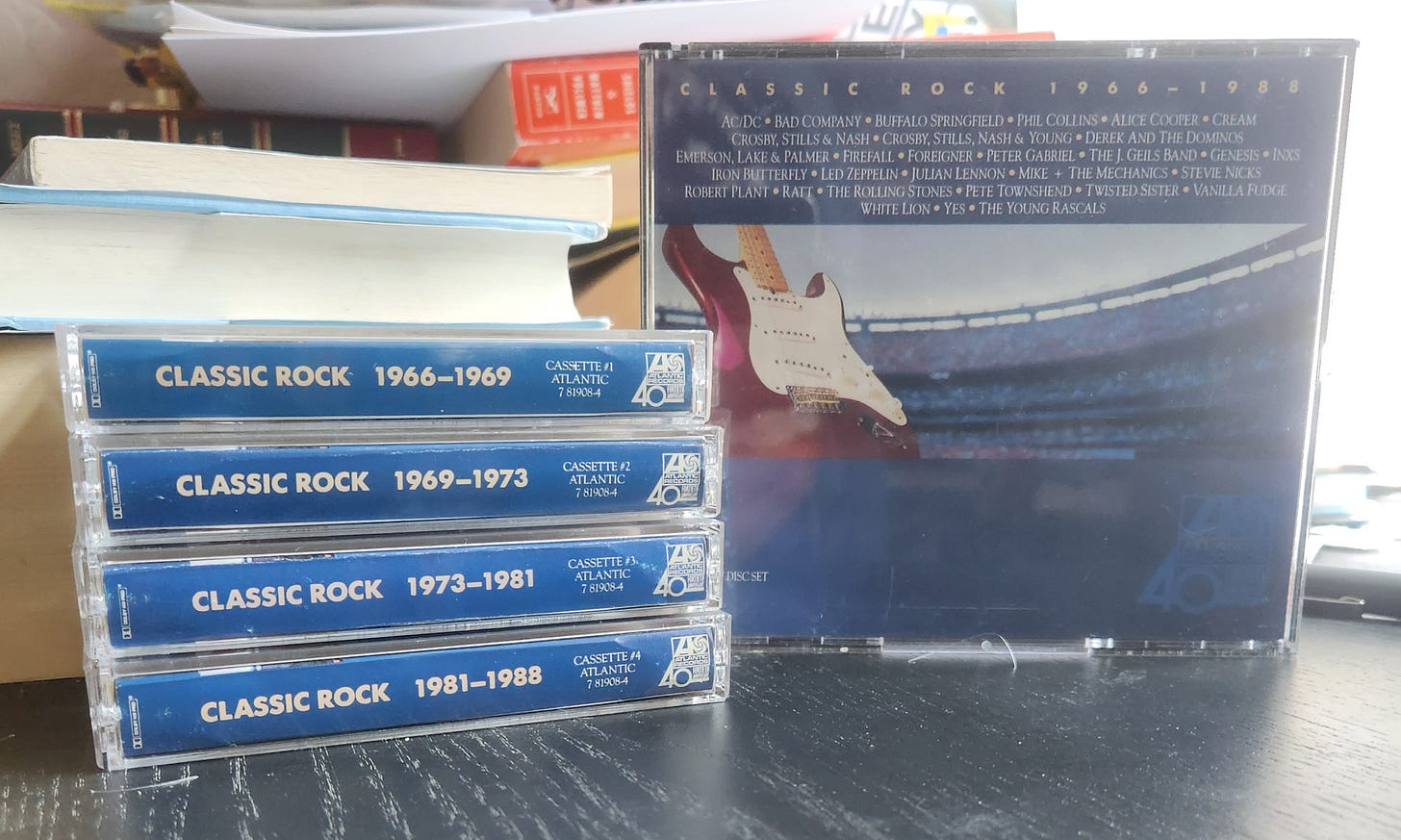
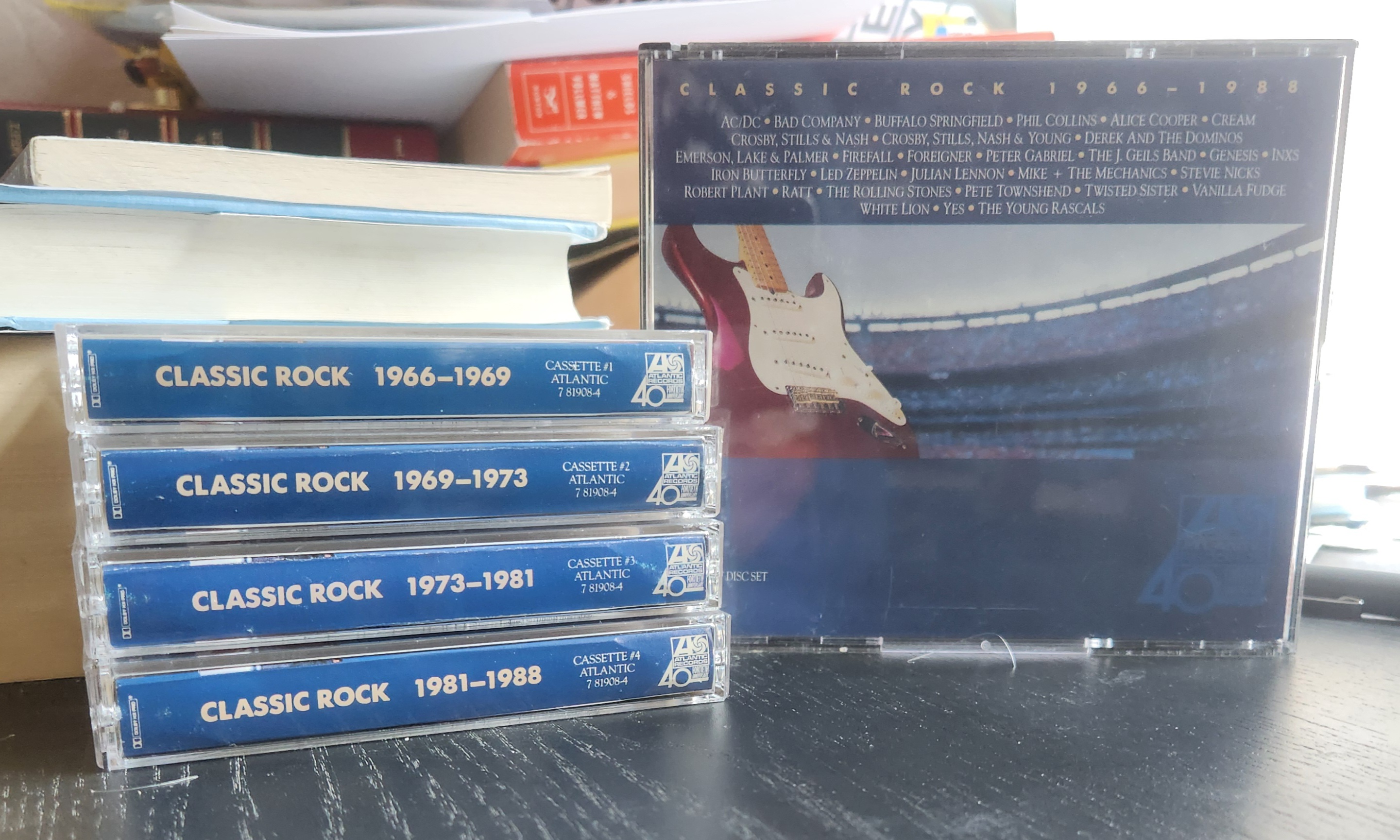
'Classic Rock 1966-1988 re-enters my life. Photo by Cory Frye.'
A rapacious sentimentalist, I’m the fella who leaves his shoes in the backyard, then collects them the following morning and contemplates the man who’d filled them the day before.
This summer I’ve indulged a penniless-freelancer obsession, repurchasing albums I owned long ago — exactly as I’d owned them, lest you think I just grab whatever format bats its cheap, pretty eyes my way. My God, I have standards.
Let’s say, f’r inst, I once bought a favored cassette and it vanished, as cassettes often did in reckless hands. Today, I hunt for that specific pressing, down to case design, j-card presentation, XDR logos, and typeface on the shell itself. Which also means that if I’m looking for a CD, I skip remasters and reissues. I must replicate the original sonic, tactile conditions of discovery, no essays or retrospective Hipgnosis work to “enrich” the experience. If my first copy’s only non-album-related text was the standard riffraff extolling the then-new tech, that’s all I want now.
Mind you, these aren’t hard-and-fast rules for collecting. I reserve this behavior for titles of personal value.
Two came recently, representing a single release in separate forms: one I had, the other I didn’t.
I bought the four-volume Classic Rock 1966-1988 on cassette in the summer of ’89. (I wasn’t too late to the party; touchy permission snags had delayed it to the prior Christmas.) A Sam Goody, ’twas, upstairs at the Puente Hills Mall, City of Industry, Southern California. All were housed in a box with a Cracker Jack prize-sized booklet. It took me just weeks to lose both forever.
I dropped about 25, 30 bucks then, roughly what I spend now. However, instead of a direct transaction across one counter, followed by immediate unshackling and study in a food court, this time I bought it while vacationing in Charleston, S.C., firing separate payments to Alexandria, Va., and Wallingford, Ct., where recipients then sent carefully reinforced packages — cargo coiled in 70 yards of bubble wrap — to my home mailbox in Peoria, Ariz. Alas, no coveted display case, no tiny book. Who has that kind of money, anyway?
As it’s 2026 and financial times have changed, I opted for the 3-CD set, too. Couldn’t have done that in ’89 ’cause a.) it was more expensive than the tapes (different story now due to scarcity), and 2.) I didn’t own a player until 1990.
The 4-LP configuration? Nah. A bit much, don’t you think?
Judging from its title, readers may assume this was some fly-by-night hodgepodge upchucked to move dead catalog on midnight TV. “Your favorite hits! Your favorite artists!” Contraire of au: Classic Rock 1966-1988 was part of Atlantic Records’ ballyhooed 40th-anniversary blitz, which included a 13-hour Madison Square Garden spectacle on Saturday, May 14, 1988. Many of the original artists were still around to perform, going all the way back to LaVern Baker, who, stage jitters notwithstanding, rip-roared “Jim Dandy” like 1956 had ended at a juke joint no one could leave.
Led Zeppelin reassembled for that event, too — Jason Bonham on skins, a year before his young foursome issued its non-Atlantic debut — though they couldn’t quite erase that lingering Live Aid chimera from three years earlier. Iron Butterfly, taut from months terrifying clubs, ate their Nordic God lunch for 14 solid minutes. Someone observed of the psychedelic ’fly, “Who took these guys out of their box?”
Yet I couldn’t have made such observations in 1989, because who the fuck was Iron Butterfly to me beyond jokes about psychedelic drugs, punchlines ending with “maaaaaaan”? I had no idea how they sounded, and descriptions like “trippy” didn’t cut it. I couldn’t run out and buy something like In-A-Gadda-Da-Vida’cause, well, where was it?
The reissue market was in its infancy, with scattershot availability in my locale. One of those burgs where if something cool snuck in, prevailing dogma drove it right the fuck out. We rarely had record stores, just chain bummers with music zones: your Fred Meyer, your Bi-Mart, your Payless Drugs, and all they carried was Top 40 and Nice Price sewage.
Not until our much-anticipated mall arrived in the fall of ’88 did cats like me have anywhere to creep. Some humanitarian installed a Camelot within. Two full walls of tapes. Twelve racks packed with longboxed CDs. Christ, it was like throwing a starving child into a Library of Alexandria made entirely of sandwiches. So the kid who bought Classic Rock 1966-1988 in this real-time golden age was just spreading the mustard long denied him. Fillings were on their way.
Despite my abundant navel-gazing, I seldom revisit this period. A time of transition, like the ’96 Suns. Call it a puberty waystation between 16 and 17, when I unconsciously dumped the before to pour the foundation of after. Before this, I wrote fiction and lovelorn poems. Now I began using cultural obsessions to study history, turning to music to re-create eras past my scope, unimaginable.
Like the ’60s.
Gotta get in to get out
Two years earlier, Rolling Stone extolled the Summer of Love, acknowledging 20 years since peace-love-dope first crossed Haight-Ashbury. I pestered my dad about it. He’d never lived in San Francisco or slept on Owsley’s floor, though he did make his own “They gave a war and nobody came” poster, which I know only because I found it in my great-grandmother’s guesthouse. Finally, he sighed, to my frustration, “I can’t explain it. You had to be there.”
Some guide he turned out to be. Nowhere were the ’60s more anodyne than the ’80s: overly lionized or heavily sanitized, stained by pathological bathos.
Why wasn’t I a part of this, too? How could my father close his eyes and instantly refabricate Bobby Seale or Abbie Hoffman, fiery, rebellious? How could he wield the spirit, speak of it with knowledge? Why couldn’t I see**a goddamned thing? He was old (well, 39); I was young. Shouldn’t I know these feelings instinctively?
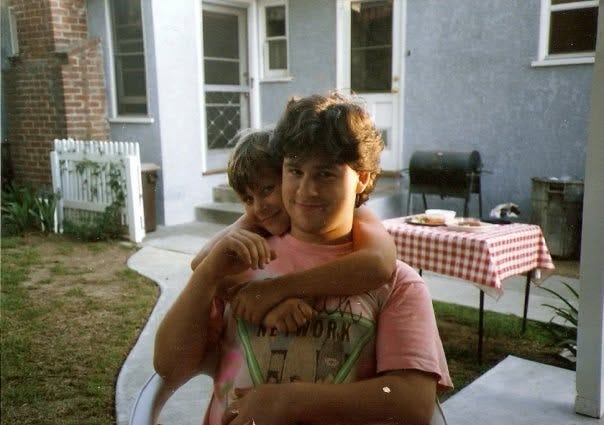
'The author and his cousin, Kristy, in Whittier, Calif., August 1989. Provided by Cory Frye.'
That summer of ’89, my father, brother, and I went, as we did every year, to visit my mother’s relatives in Whittier, California. Quaker Quorum, Nixon Country. I spent a week working for my uncle, repairing homes still cracked from the Whittier Narrows earthquake. Mostly, I stood on ladders with electric sanders, listening in spurts to Queen’s The Miracle, guzzling Cherry Coke, and privately philosophizing on such subjects as how neighborhood dogs transmitted useful information to one another.
True to my teenage nature, after receiving my first check, I bounced and chilled. I had money, so I’d accompany my aunt everywhere on the off chance there were tapes to acquire. Newly mad for psychedelic Pink Floyd, I found a copy of Atom Heart Mother at Target (Atom Heart Mother! At a fucking Target!) and grabbed Classic Rock 1966-1988 at Sam Goody.
The advertised bands sold the purchase: Yes, Zeppelin, Genesis, Derek and the Dominos’ “Layla,” Kick-happy INXS (“New Sensation,” not Listen Like Thieves U.S. breakthrough “What You Need”), White Lion, even the Rolling Stones. This wasn’t K-tel/Ronco vomit but a seriously curated set of known hits and semi-obscurities, a classic-rock station with a zonked-out DJ who sometimes veered off the playlist’s cliff.
I knew little of its production, but just look at those marquee credits. Perry Cooper and Bobs Kaus and Porter, gods all, venerable label lifers tunneling through archives to present an unconventionally satisfying various-artist collection. Heavily white,**however, save bassist Calvin “Fuzzy” Samuel. True, it featured big names, yet it followed careers from development to the then-present day.
“I think we took the songs that best signified each era,” Cooper said at the time. “We narrowed it down, which is never easy — look, it could have been a 30-album set — and I think we’ve priced it within the economics of the people.”
That track list, though. Even classic-rock radio never ventured past the universally recognized Genesis, leaving tire marks around “Follow You, Follow Me” from And Then There Were Three … (1978), the natural math following the exits of guitarist Steve Hackett in 1976 and original frontman Peter Gabriel a year earlier. Classic Rock goes further back, to “The Carpet Crawlers,” heard nowhere in 1989 but on The Lamb Lies Down on Broadway(1974)**or Seconds Out (1977). That Gabriel, Classic-repped by “Solsbury Hill” from one of his multiple self-titled cannonades, had ever been a member was a general trivia question to win DJ giveaways, not a well-known, well-consumed truth.
My generation knew The J. Geils Band as a goofy, affable singles act with hits like “Freeze Frame” and “Centerfold.” Imagine my shock to discover them as inveterate blues/boogie jack ’n’ packs on “Give It to Me,” where I actually heard J. Geils’ guitar speak at length, where Magic Dick was a mouth-harp whammer-jammer, not a wild-hair in shades looking for something to do. And I’m pretty sure Peter Wolf, long a rubber-limbed gangster, fucked swaths through concert halls years before drooling over homeroom angels.
Iron Butterfly’s full “In-A-Gadda-Da-Vida” — all album-length versions on this package — sits between Buffalo Springfield’s “Bluebird” and “I Am a Child” (no “For What It’s Worth” whatsoever), a unit that splits into Crosby, Stills & Nash (“Suite: Judy Blue Eyes”) and Crosby, Stills, Nash & Young (“Ohio,” featuring the aforementioned “Fuzzy”), then back to CSN again, attired now as casual-Friday yachtsmen (“Southern Cross”).
Yes drops in with “I’ve Seen All Good People” and “Heart of the Sunrise” and reappears with “Owner of a Lonely Heart,” romping with fellow apostatic proggers Genesis (“Tonight, Tonight, Tonight”), whose drummer dropped a trademark bomb alone (“In the Air Tonight”) and whose bassist commanded Mike + the Mechanics (“All I Need Is a Miracle”).
The fucker even boasts a Who vet (“Rough Boys”) and a Beatle kid (“Valotte”). It roots in psychedelia (Cream, kinda, and Vanilla Fudge, for Christ’s sake), sheen-spiked commercial metal (Twisted Sister, Ratt), hard-party white boogie (Bad Company), corpo synergy (Foreigner), and country rock (Firefall). Zeppelin cranks “Dazed and Confused,” “Whole Lotta Love,” and “Stairway to Heaven” so that Robert Plant can drag everyone past the future’s doorway to “Tall Cool One.” And let’s not even get into the Stones’ Sticky Fingers/Some Girls strut through Ahmet Ertegun’s stable.
I mean, holy shit. This thing was builtwith longevity in mind, to teach. How did this band become that band, and what did it impart to members who set out on their own? What transpired in the air around them, through popularity and even death? AC/DC’s “Back in Black” follows hot on “Highway to Hell,” rendering a swerve from the lost Bon Scott to savior Brian Johnson somehow more immediate.
Why does Vanilla Fudge’s fuck-warped “You Keep Me Hanging on” — Holland/Dozier/Holland as smoked in a basement — work in its, our, and the future’s time? What went down between ’66 and ’88, and how did Atlantic respond? It’s all here to be found, from an era before endless repackaging, when exploration wasn’t an algorithm. I’m no longer the only boy on my block familiar with Emerson, Lake & Palmer’s “Karn Evil 9/1st Impression, Part 2.”
The question now, of course, is why buy this ancient tablet when I can populate a Spotify playlist with the same songs, if multiple don’t exist already? I think that’s out of respect for the original compilers who purposefully fucked with a tired formula to create something worthwhile, mastered into cohesion by Ted Jensen. This undertaking reached pubescent suburbanites in desperate need of education. There’s value in acknowledging that.
I took at least one wrong lesson from their genius during my own label flailing — “Remember this band? Love this band? Well, live through thisunrepresentative**deep cut, bitch!” for most of a boxed set — but Classic Rock 1966-1988 remains a master class in the semi-lost art of various-artist statements as communication. Anything to initiate the thrill of the chase.
And for that, my friends, you need shoes.
Classic Rock 1966-1988**(1988, Atlantic, 7 81908-2/7 81908-4)**
CD 1: 1966-1970 (Cassette 1: 1966-1969) The Young Rascals, “In the Midnight Hour” Buffalo Springfield, “Bluebird” Iron Butterfly, “In-A-Gadda-Da-Vida” Buffalo Springfield, “I Am a Child” (Cassette 1, Side 1 ends) Cream, “White Room” Vanilla Fudge, “You Keep Me Hanging on” Led Zeppelin, “Dazed and Confused” Crosby, Stills & Nash, “Suite: Judy Blue Eyes” (Cassette 1, Side 2 ends) Led Zeppelin, “Whole Lotta Love” Derek and the Dominos, “Layla” Crosby, Stills, Nash & Young, “Ohio”
CD 2: 1971-1978 (Cassette 2: 1969-1973) Yes, “I’ve Seen All Good People // A. Your Move, B. All Good People” The Rolling Stones, “Brown Sugar” (Cassette 2, Side 1 ends) Led Zeppelin, “Stairway to Heaven” Yes, “Heart of the Sunrise” The J. Geils Band, “Give It to Me” (Cassette 2, Side 2 ends) Emerson, Lake & Palmer, “Karn Evil 9/1st Impression, Part 2” Bad Company, “Can’t Get Enough” Genesis, “The Carpet Crawlers” Alice Cooper, “Welcome to My Nightmare” Firefall, “You Are the Woman” Foreigner, “Feels Like the First Time” (Cassette 3, Side 1 ends) Peter Gabriel, “Solsbury Hill” The Rolling Stones, “Miss You”
CD 3: 1979-1988 (Cassette 3: 1973-1981; Cassette 4: 1981-1988) AC/DC, “Highway to Hell” AC/DC, “Back in Black” Pete Townshend, “Rough Boys” Phil Collins, “In the Air Tonight” (Cassette 3, Side 2 ends) Foreigner, “Juke Box Hero” Stevie Nicks, “Stop Draggin’ My Heart Around” Crosby, Stills & Nash, “Southern Cross” Yes, “Owner of a Lonely Heart” Twisted Sister, “You Can’t Stop Rock ’n’ Roll” Julian Lennon, “Valotte” (Cassette 4, Side 1 ends) Ratt, “Round and Round” Mike + the Mechanics, “All I Need Is a Miracle” Genesis, “Tonight, Tonight, Tonight” INXS, “New Sensation” White Lion, “Wait” Robert Plant, “Tall Cool One” (Skid Row’s “18 and Life” added to 1991 U.S. reissue; “Highway to Hell” moved to Disc 2)
Reissue produced by Perry Cooper, Bob Kaus & Bob Porter Executive producer: Ahmet Ertegun
About Cory Frye:
Cory Frye is a Society of Professional Journalists and Oregon Newspaper Publishers Association award-winning writer and editor whose work since 1991 has appeared, variously, in the Oregonian (Portland, OR), the Albany Democrat-Herald (Albany, OR), Corvallis Gazette-Times (Corvallis, OR), Maggot Brain, Under the Radar, Hit List, Yahoo! Music, and the Rock & Roll Hall of Fame. From 2000 to 2007, he was a writer, researcher, and editor for the Rhino Entertainment record label in Los Angeles, where he even co-produced a pair of releases: the deliriously slaughtered Whatever: The ’90s Pop & Culture Box (2005) and the better-acclaimed Afghan Whigs career compendium, Unbreakable: A Retrospective (2007). In 2015, he published his first book, Murder in Linn County, Oregon: The True Story of the Legendary Plainview Killings (Arcadia Publishing/The History Press). His second, an in-depth biography of the Rowan & Martin comedy team, is planned for 2027.
More from this column
- News flash: PHX Zine Fest 2026 kicks off tonightSeptember 25, 2026
- News flash: Let's Ruin Our Lives September 15 in PhoenixSeptember 15, 2026

